Buster Keaton
The Hanover Theater in Worcester MA recently put on a fantastic afternoon of entertainment featuring films by famed silent screen artist Buster Keaton with Carl Wilson accompanying on the Wurlitzer organ. A large crowd turned out on a blustery Sunday in March to be part of this magical afternoon at the movies. The two films shown were, One Week, originally premiered in September 1920 and Sherlock Jr, originally premiered in April 1924.
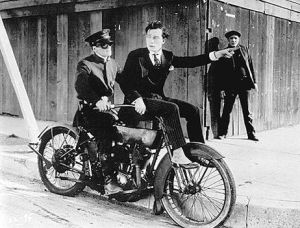 Joseph Francis Keaton was born on October 4, 1895 in Piqua Kansas. The legendary magician Harry Houdini is credited with giving Buster his nickname after watching him take a hard tumble and bounce back without much fuss. He is widely quoted to have said, “that was a real buster” when the toddler fell. Buster started performing on stage with his family at the age of 5. He was a veteran performer and gifted acrobat when he moved into motion pictures. Buster began his film career in 1917. By 1920, he had his first short film premier of One Week.
Keaton, Charlie Chaplin and Harold Lloyd are widely regarded to be the three geniuses of the silent screen for comedy. Buster was an actor, director, writer, editor and stunt man. He starred in 19 short and 25 feature films. There are umpteen feature film appearances, cameos and television roles to his credit. His style of comedy was distinct. His deadpan pale expression and pork pie hat cloaked a vibrant, visual artist who had a perfect ability to convey in body language what was happening in his thoughts. He was often called, the Great Stone Face. A more clear expression of emotion and energy has not been duplicated in another actor. He is fascinating to watch move on the screen. He understood how to build tension and surprise into a scene. He was extraordinary at staging complex scenes that required expert control and timing. He used or created the latest technique with the camera to craft visual artistry set at a distance and with things in motion. Some would argue he is one of the most influential actor, director, cinematographer and editors in American film history. Certainly, the novelty of watching these films as they were presented at The Hanover Theater greatly enhanced the entertainment value. The large screen, darkly lit theater, and that organ playing away created an almost carnival atmosphere.
One Week & Sherlock Jr
 One Week is a short film of twenty minutes. The plot revolves around Buster and his new bride receiving the gift of a house lot and kit house. The bride’s former boyfriend, in a moment of revenge, mixes up the numbers on the boxes and Buster puts together one crooked house. We watch as Buster and bride settle into home sweet home.
Sherlock Jr is a long film of forty-five minutes The plot revolves around Buster who has a job at the local cinema in the projection booth. He wants to become a detective and is busy reading: How To Become a Detective. Buster spends his last $1 on a box of candy for his girl. He replaces the $1 written on the box with a $4 to inflate the value of the gift. At her family home, we see Buster flirting with his girl. His rival also visiting at the house, robs her father of his pocket watch, and sells it at the pawn shop for $4. Back at the house, the watch is discovered missing, Sherlock Jr, sets about plying his new vocation. But, the rival has put the pawn ticket in Buster’s pocket. The ticket is found. The family think he stole the watch. Buster is asked to leave and not return. Back at the projection booth, a disgruntled Buster falls asleep and we watch him have a vivid walking dream. His dream self stands up, walks into the theater, walks into the film being shown and has an amazing adventure. When Buster awakes from the dream, the truth has been discovered about the theft and he reunites with his girl. Buster, a bit hapless at romance, mimics the action on screen between two lovers to woe his girl. He wins back his reputation and the girl!
The dream sequence in Sherlock Jr is often mentioned as one of his most impressive achievements on  film. In the days of silent film, the camera was static and cranked by hand. The cameraman was a critical part of the film making process. He had to maintain a steady speed of reels per second as the action unrolled before the lens. Buster had to have spent hours preparing many of the gags we see on the screen. The dream sequence is remarkable in its use of a double image of Keaton on screen. Buster falls asleep in the projection room, his sleeping self-wakes up, steps out of his body and roams into the movie theater. When he doesn’t like the way the scene is going, he steps into the film! He becomes part of the action on screen. The dream imagery starts shifting around literally under his feet. We watch as Buster appears in different landscapes in rapid succession. He is on an iceberg, a mountain top, in a lion’s den, at the ocean, in the desert, etc… All in the blink of an eye. The amazing thing is that his position is perfect to the change in scenery. I believe he used a surveyor in order to make sure he appeared in the exact same spot with each shift in the landscape. It was a brilliant visual cinema achievement. Click on this link to watch the Dream Sequence.
Keaton’s Magic
The synopsis of the films reveals a solid plot for each story. Buster’s characters lead, rich, full lives. They routinely win the affections of the girl and marry. He is usually gainfully employed or finds clever ways to make ends meet. He is a jack of all trades. He can be dressed like a vagabond or strutting about in tails. Above all, he rolls along with what life dishes out and comes out a winner. He has a healthy moral base that others take advantage of. Despite the rough and tumble life depicted in many of his films, he always tries to keep to his beliefs and carry on. His day is filled with one adventure after another. Buster’s characters are charming and reveal a keen perception of day to day life. His insight into human behavior helped him connect to his audience as a man, as one of us and as one whom we’d most like to be. He is a hero where you’d least expect to find one.
“Down through the years my face has been called a sour puss, a dead pan, a frozen face, The Great Stone Face, and, believe it or not, “a tragic mask.” On the other hand that kindly critic, the late James Agee, described my face as ranking “almost with Lincoln’s as an early American archetype, it was haunting, handsome, almost beautiful.” I can’t imagine what the great rail splitter’s reaction would have been to this, though I sure was pleased.”
― Buster Keaton, My Wonderful World of Slapstick
The films were highly entertaining, imaginative and fun to watch. The Wurlitzer organ gave the story musical life and exciting drama. An occasional placard would appear on screen to help the audience understand the story. However, they are few and far between. The movements, gestures and expressions clearly take the viewer along on an adventure. It’s cool to appreciate how funny Buster was and still is in 2015. The comedy is a little knock’em down at moments, but largely it is how Buster gets himself in or out of a predicament. How he makes the best of it despite circumstances. Buster’s stance is somehow nestled in sweetness and the appearance of composure in the midst of unending chaos swirling around him as he never gives up and never gives in. In his graceful, acrobatic manner, he steps into the light and carries on. There is something beautiful and enduring about Buster Keaton. If ever the opportunity comes to see one of his many outstanding feature films such as: The General, The Navigator, Our Hospitality or Steam Boat Bill Jr., go, take your family, your friends or yourself for an afternoon of first class comedy and entertainment.
In a rating of 5 stars: One Week 5 stars, Sherlock JR 7 stars
Film: One Week (1920) Cast: Buster Keaton, Sybil Seel
Directed and Written by: Edward Cline, Buster Keaton
Produced by: Joseph M Schenck
Premier Release Date: September 1, 1920 1st Keaton short film
Length: 20 minutes
Film: Sherlock Jr. (1924) Cast: Buster Keaton, Kathy McGuire, Joe Keaton, Ward Crane, Erwin Connelly.
Directed by Buster Keaton
Produced by Joseph Schenck and Buster Keaton
Premier Release Date: April 21, 1924
Length: 46 minutes
Written by Frances Ann Wychorski April 2015
@FrancesAnnWy2015
 The definition of what it meant to be an American was a point of confusion as I was growing up. As a nation of immigrants, the majority of us can trace ancestry to a distant shore. The Native Americans may have a wholly different understanding of immigration with the disastrous outcome for an entire race of people. Newly arrived immigrants come here for the hope of a better life while coming to terms with what has been left behind. Truly, some may spend the remainder of their lives with a foot in both worlds. Immigrants as well as second, third and fourth generation Americans often apply a label to their identity in order to establish roots of ancestry. This is an important factor in socialization. Having been raised in a 2nd generation home, I can identify by association of place to being an American confused along with a thread of connection to the founding ancestry.
 Worcester is a city of seven hills. The neighborhood I came from is referred to as Vernon Hill. In its day, the area was notable for its Americans descended from Polish and Lithuania immigrants. The foundation of the community is the Lady of Czestochowa Catholic Church. The imagery of Mary is strikingly different from the anglicized version. There are many legends associated with this portrait. She is a woman of beauty, youth, wealth and power. There is nothing passive about her. She would not be burned or lost to nonbelievers. A hint to the reader of how strong the identity to the motherland still is can be conveyed simply. In attendance at a funeral in this old church in 2013, in the vestry hangs a picture of Pope John Paul II. He died in 2005. He has been replaced by two (2) popes. Yet, this church still honors his ancestry and identifies with him through it. This is how strong the confusion can be to place of identity. The faith is based in a foreign church, not the American Catholic Church, but that of Poland.
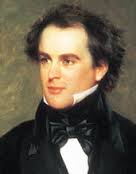
 I have never recovered from this sentence. He is describing the space between the street and front door of the old house. One does not simply walk to the front door, one passes through the veil between the worlds along the way. Hawthorne had a genius with lyrical prose. As a writer, he had a sensual, enveloping style of storytelling that wrapped the reader into his world and that of his characters.
 A humbler token of the fight, yet a more interesting one than the granite obelisk, may be seen close under the stonewall, which separates the battle-ground from the precincts of the parsonage. It is the grave–marked by a small, moss-grown fragment of stone at the head, and another at the foot–the grave of two British soldiers, who were slain in the skirmish, and have ever since slept peacefully where Zechariah Brown and Thomas Davis buried them. Soon was their warfare ended;–a weary night-march from Boston–a rattling volley of musketry across the river;–and then these many years of rest! In the long procession of slain invaders, who passed into eternity from the battle-fields of the Revolution, these two nameless soldiers led the way.”
  LuceStellare