An Unplanned Pilgrimage
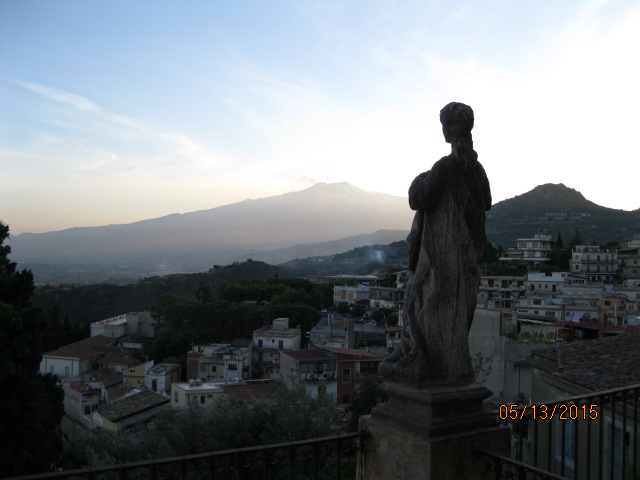
The first night in Sicily was passed at Casa Cuseni. In wanting to know something about travel in Italy, I happened upon Daphne Phelps memoir “A House in Sicily.” The Casa was built in 1910 by her uncle Robert Hawthorn Kitson of England. Kitson was a talented watercolorist who travelled around the Mediterranean collecting and preserving fine art objects. After a second bout of rheumatic fever, his doctors urged him to move away from English winters. He settled in Taormina long before it became a popular tourist destination. He chose it partially because of the view to Mt. Aetna.
In 1947, Phelps inherited the estate. At the time, she was a single, professional woman in the prime of her life working in England as a psychiatric social worker specializing in care for children. Her book provides insight into the turmoil immediately after World War II. Traveling in Europe for business was difficult to arrange. Yet, she had the responsibility for a house and went to Taormina with the intention of selling the estate. Once she arrived, the legalities of taking on the house proved complex. Phelps spoke little Italian and lacked cash. The two story house came with a cook, manservant and cleaning staff. After a buyer backed out; Phelps decided to keep the casa.
The house, gardens and furniture were designed by artist and illustrator Sir Frank Brangwyn. Because of her late Uncle’s vast connections in the artistic community, and a large dash of charisma, Phelps turned the Casa into a guesthouse for notable writers, painters, poets, and designers for rest, relaxation and inspiration. Artists could stay for weeks, months or an entire season. A few of the artists in residence included Greta Garbo, Coco Chanel, and Tennessee Williams.
At least in the pages of the book, Phelps seemed to be a most capable and resourceful British woman. The words, perhaps it cannot be, did not fit into her vocabulary. She made the best of it and established relationships with her staff, the locals and even the regional Mafia don. Phelps displayed an independence of character rarely seen by Sicilian men and women. She managed her business and social affairs. She kept and drove a car, took extensive trips exploring the different regions getting close to the vast, complex history of the island. She lived a rich, full life without a man at her side. If she was involved with someone, those stories were kept private. Her voice came easily off each page.
Phelp’s words sounded similar to my thoughts about this trip. She wrote about Sicily being the great unknown land. Historically, Taormina has been a destination for relaxation and vacation dating back to when it was part of Magna Grecia and, for centuries a more relaxed place to live a non traditional lifestyle. People of different inclinations are welcome. Sicily offered Phelp’s an exciting life filled with folklore, history, archaeology and botany. The climate is gorgeous and the butter yellow house with the sky blue doors alive and welcoming.
My spirit is cautious, her vitality fascinated me. Besides, she was talking about a lifetime commitment; and retelling how she bonded with the place and its people. My trip to Sicily was only for three weeks. The members of the short-lived tour group did not want to stay there, nor had the connection a reader makes to characters in a story. It was part of my dream to go to the island and visit Taormina. I had to stay at this house. Not to merely pass by, but to be in it.
My driver went around the narrow streets circling the hillside until we came to the Casa on avenue Via Leonardo da Vinci. Roads in Sicilian towns do not have curbs. Most are narrow with stone walls on both sides making a stop at the side of the road risky. When we arrived at the gates, the driver rang the bell for entry. An awareness of the preference Sicilians seemed to have for sturdy gates and locks started here. The keyholes oiled and smooth. The gates hang straight on their posts and swung easily. The proprietor hands over the keys without hesitation. Every place I visited in Sicily had this same understanding of what the Italians refer to as sistemarsi; or how one lives at home.

Drawing by Domenico Minchilli
The walk to the front door of the Casa meandered through a large tiered garden filled with citrus trees of mandarin oranges, grapefruit and lemons. Water trickled out of a lion’s mouth into a wide basin of smooth white stone. It was a long way up to the south-facing front terrace on stiff, sturdy stone steps. A big sky blue door led inside. How delightful it was to walk up the shallow steps into the grand Casa. The hallways are cool and dim. The windows were floor to ceiling, looking out towards the bay. Phelps and all her guests once walked this way; it was exciting and humbling to be where their feet had passed.
The first floor had a small office right off the entryway. Two pen and ink drawings by Picasso hung on the wall. That was the power of Phelp’s spirit. At the very back of the house was a large kitchen with tall ceilings. The floor was a few steps below ground level giving a sense of coolness to the space. Next to this was the large formal dining room with painted walls wrapping around the room telling the story of a relationship between two young men. It’s faded a bit but was originally done by the architect, Brangwyn. Considering when the house was built, it must have been a refuge for English people of the day.
Adjacent to the dining room was a parlor facing a wall of French style doors that opened out onto the terrace. Upstairs were five guest rooms, some with ensuite baths and others shared a bath in the hallway. On the third floor was the large dining area with a small modern kitchen off to the side. It was so very comfortable to walk on the stairs, they were wider than average and somehow not so tiring as the old stone steps in the garden. My room on the second floor was fitted with English furniture with floor to ceiling curtains in front of a double door leading out to the balcony.
Dear reader, I will not ever recover from my first up close view of Mt Aetna. It was enormous. Once before, I’d had the sensation of being able to step into another non corporeal presence. Years ago, I’d been stargazing at Jupiter in the summer sky. The view was so clear and powerful, I felt its energy. I made a connection to something greater, something alive. The feeling was of lightness and as impossible as it was; the ability to step easily off this planet and onto another. Aetna did the same.
At first, I thought a person was standing there on the balcony.. Human-sized statues of young women in flowing garb were poised at the edge of the balcony. Each one looking directly at the smoking summit. There was a solidness coming from them. They are so old and the carving so exquisite that they felt alive. The placement was perfect. An artist carved these figures hundreds of years ago but, where did they come from? Are they guardians of the Casa? They must have names. I wanted to stand there and watch with them forever.
There had been an eruption the day before with lava flow visible in the night. The Mediterranean with its calm azure waters keep Aetna’s feet cool as she gently rumbles. My balcony view looked out to the Gulf of Naxos with twinkling lights all around the bay. The city bustled below me but the house created a sensation of stillness. I am from Massachusetts where houses are made of wood. Stone was quiet; and did not squeak or feel warped under foot. The rooms in the house were all wider than average with 15’ ceilings. The wood floor laid out in a herringbone pattern. The stone walls gave a feeling of privacy. Henry Faulkner stayed in this room while a guest at the Casa. On the walls were several of his watercolors. The double bed was comfortable. A small fireplace was built into a corner of the room. There was no closet, only a curtain drawn across the corner. Behind it, a bench held extra pillows and blankets. A few coat hooks held up a bathrobe.
The shared bath in the hall was clean with abundant hot water. The bathroom window looked into a small, serene courtyard with a large sun-bleached peddler’s cart waiting to roll out into the street. It now sits quietly in this shady place. In parts of Sicily, there are still the mercato ambulante (peddler) who roam through town. He ambles through the maze of avenues pulling just such a cart. “Fresh strawberry! Fresh mulberry!”, he calls. I love quiet places and could have stayed at the B & B the entire visit, never stepping out into town but content nevertheless for being there. Perhaps when I die, I can transfer my energy into the statuary and remain on watch as the years roll by.
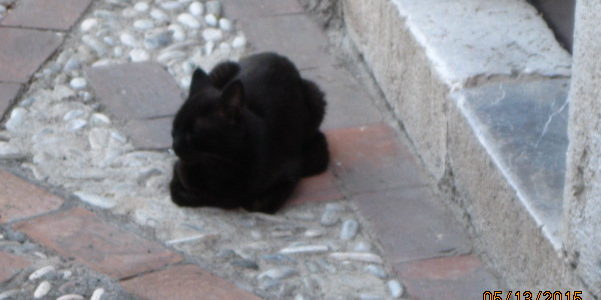
After an hour or so settling in at the Casa, I walked around the main corso in Taormina. I was brave to go out and walk about in a strange city. I had to go out a little, if only for a bite to eat. The English speaking son of the house manager, Franco, said to go across the street, walk down the stone steps and take a left into town. Everything is up or down a hill there. There was a warren of side alleys into different parts of town. The stones were clean and smooth underfoot. I found a relaxed black cat resting on the warm stone steps leading into the heart of the town. He did not look up when I passed by, but sat content, quite at home in this spot. I thought of Mimi cat back home, what is she doing now?
My footsteps lead to my first taste of arancini, little oranges which is what they look like. It’s a rice ball made with meat and cheese in the center surrounded by a light coating of breadcrumbs pan-fried in olive oil. A Sicilian fast food. Kids were break dancing in the square. The sun was strong here, I knew I needed a sunhat to be safe. The little woman in the hat shop set my choice aside; I had not quite enough cash, until tomorrow, a domani, a domani.
I slept with the doors to the balcony open that night. I kept getting up to look at the lava flow crimson against a black mountainside. The air was a bit cool but I loved the curtains, the double doors and hearing night sounds. The mourning doves made a different coo here. At home, they sound soft as if humming with love found. In Sicily, they sound strained, as if the answer from longed for mate never comes. Funny, there were no screens on any windows or doors. In that first halo of arrival, it seemed even the bugs were kind to tourists. My stay was brief but I had the experience of being in the presence of beauty and the living artistic energy embedded in the cream stucco walls.
Fans of Phelps memoir will be delighted to know that Concetta’s daughter Mimma and her husband now own and manage the Casa. Concetta was the loyal cook and housekeeper of 50 years. What a thrill it was to meet her. I only regret not meeting Don Ciccio’s descendants. Phelps spoke so often and with such fondness of the Don that I did have to ask her was their relationship more than platonic? Mimma thought not but said Phelps was a free spirit in matters of love and it was a possibility.
The name Daphne in Greek mythology is synonymous with a Naiad or fresh water nymph. The sprites are found in wells, streams, springs and fountains. Gentle beings in gentle places providing soothing, cool waters. I heard the small fountains flow all night Gentle splashes, gentle everything. I used to think of myself in this way. I was kind and quiet, that side of me had been pushed into a corner so often, that she was lost.
After a night’s rest and a plentiful Italian breakfast of brioche, prosciutto, yoghurt and granola, I passed the morning visiting Isola Bella, a small preserved nature park in the bay of Mazzaró. Visitors to the island reach it by walking along the shore and crossing a shallow isthmus. The beach didn’t have sand but bits of quartz and smooth stone. It was popular with sunbathers and women offering foot massages. A small fee allowed visitors to enter the park and walk among its cool paths, rock formations, natural rooms made of stone, and small shallow caves. The park boasts beautiful fauna. I recognized bird of paradise, but had never seen it in a natural state. How exotic the plumes of black and orange flowers among the tall spiky leaves. I looked toward shore and saw tour boats offering excursions into the bay. I could hear one of them returning back to port playing the overture to Rossini’s “The Barber of Seville”. A little kitschy but, that’s okay.
Anyone visiting Taormina must see the Teatro Antico Greco. The ancient Greek Theater has attracted artists since the 2nd century AD. The open-air amphitheater was in frequent use during the tourist season staging plays, ballets, operas, and musical performances nightly. It was an absolute wow to walk around the site. The tiered seating was made of cut block stones giving each person a good view to the stage. Wildflowers grew around some of the seating and gave it a pastoral look. The footing was flinty and dusty, I was glad for my sturdy shoes. The theatre was and was not a ruin. The stone backdrop to the stage crumbled down in places. It looked solid and not about to tumble over yet large chunks were missing. However, it was clean and swept along the paths. Every view was majestic. Ever-present, Mt Aetna watched over. Perhaps that was why the locals cope with the proximity of a live, active volcano in their backyard. She’s kept preoccupied by the artists and soothed by many a lovely song. She would not want to interrupt the show below.
The best pizza pie I ever ate was in Castlemola, a small town above Taormina. The Caffe bar Turrisi at the top of a long, steep windy road just off the car park, served an exquisite pizza with a spicy Sicilian picante sauce. The blend of a little heat, a lot of flavors with fresh just made crust and mild mozzarella cheese was beautiful. It was very easy to eat the entire pizza. By the hour, I was enjoying Sicily more and more. It was remarkably old and modern all at once. The service everywhere was good. Whether you could speak Italian was not a concern. Curiously, besides my neighbors at the Casa, I met no other English-speaking tourists. Everyone was from Germany, Holland, France or other parts of Italy. Not one American crossed my path in Taormina. I had the sensation I had been here before and it had not been one day but a 100 already. My only regret was not having come ten years ago to have met Daphne. She died in 2005 at the age of 94. I felt her presence in the Casa. I had the expectation of meeting her in the hallway and not being surprised. I don’t believe in ghosts, but in the spirit of all things. Daphne’s spirit is in the brick walkways. Her fingerprints are still on the whimsical little statues littered around the garden. They planted the seeds of the lemon trees in the garden.
#sicily #casacuseni #travelsicily #taormina
 LuceStellare