How to Appreciate and Listen to Opera
Perhaps it’s a moment tuning the radio dial and there it comes, an exciting flurry of classical music and voice in a language that is not quite clear. Or, in the memory of a grandparent who played an Enrico Caruso album on Sunday afternoons. An old curiosity lost through the years given to education, labor, parenting and aging. For whatever reason, the interest to appreciate opera comes and so what to do? How can the average person gain entry into this fine art. It can be done, with a few suggestions from an opera novice, it can be done. I started my intensive journey into opera several months ago and am excited to encourage others to give it a try. To make this an inviting experience to the newbie, instead of lines of dry text, I will post a short operatic piece and hopefully, describe in language using the lingo of opera, what is being heard and what is happening. As in the study of a new language, it is best done in short sessions. This is the first of several articles to be presented here. Hopefully, the beauty and delight I have found will encourage the curious beginner to explore.
Opera at its core is story telling expressed through the fine arts of music and song. Opera is the human experience of emotions, desires and dreams.
My background in classical music is that of a concentrated listener. I did take piano lessons for several years but put no claim to being a pianist. From an early age, I listened to classical music, particularly Frédéric Chopin. His nocturnes and concertos were often heard in the home to honor his and our Polish heritage. When I was a teenager I gained an appreciation of Beethoven’s Symphony No 5 during a summer vacation. My family rented a home in Vermont for a week. The house came with a stereo system and several classical music albums. Curious to hear an entire symphony, I played this every evening fascinated by the energy and beauty of it. Years later, I acquired a cassette tape of Operatic Arias by Placido Domingo. On Friday afternoons, I enjoyed turning up the volume every time. Maestro Domingo’s voice has a lifting quality. Domingo sings with passion and that energy connected in me. The interest was long there and these moments stand out in memory among many.
Foreign Language Skills Not Required
The reader may be relieved to know it is not necessary to have one word of a foreign language to understand the story. Opera performers must have a fine voice for singing and capable acting skills. The singer often exaggerates the language it is in. The composer has crafted the music and the voice to present and give the audience the opportunity to hear an expression of optimum beauty. The goal of an opera, is to move you emotionally. Much of acting is body language and facial expression. A good opera performer combines these theatrical arts.
However, the beauty of opera is a combination of the story (libretto), stage setting, costume, voice, instruments, theater and the musical composition.
An opera is grand theater. I say with some comfort that a fairly large amount of the audience attending any opera may not speak the language in which it is sung. However, having an ear that is accustomed to hearing foreign languages will be helpful. I was raised in a culturally diverse city in Massachusetts. The neighborhoods were defined by culture and language. Riding the city bus through the city, block by block the languages changed from Spanish to Greek to Lebanese, etc…I was raised in a household where Polish was spoken with regularity. I have studied Polish, French, Spanish, Japanese and lately Italian languages. I am not fluent in any but get by best in conversational Italian. My major in college was International Studies. The exposure to different cultures is something I embrace and enjoy. Opera is an opportunity to explore different cultures as entertainment.
Opportunity to View
One way to access quality opera recordings may be through the local public library. There are a number of DVD’s of popular operas for loan available with English subtitles.
The Metropolitan Opera at Lincoln Center in New York City simulcasts performances to local theaters. This is an excellent way to attend. The performance will have a host to explain the history of this opera along with a brief synopsis. The opera will have English subtitles on the screen. The Met is meticulous in costume and stage detail.
You Tube has numerous performances from single arias to a complete opera.
PBS Television airs a program titled: Great Performances. Viewers can check their local listings for the weekly showing. The program aired this week has: Le Nozze di Figaro (The Marriage of Figaro) by Mozart. This is one of the most famous operas ever performed and one every opera fan will hopefully enjoy knowing well.
Baptism by Barone
The opera bug had been inside me for years but in a state of dormancy. The curiosity and desire to know this fine art has been reborn in the person of Piero Barone.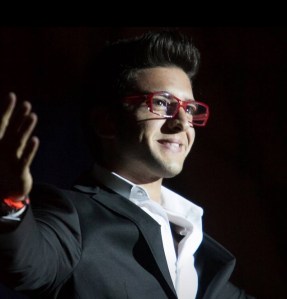 The name alone is quite poetic and conjures up an image of a romantic Italian singer. Barone is a member of the trio of singers from Italy named IL Volo. In September of 2013, I attended an IL Volo concert in Boston, MA. I became a fan after viewing a performance on PBS Television. I was impressed by the quality of their voices and the natural charm beaming through the camera. The group has as members also Ignazio Boschetto and Gianluca Ginoble. They sing a wide range of music and are interpretive artists. The range of musical presentations includes classics from Broadway, cinema and pop. They also perform classic Italian favorites as well as an occasional operatic piece. The trio include a light baritone, lyric tenor and a dramatic tenor. The group sings each song in a unique style with each singer performing a solo verse but ensemble in the chorus. The effect to the listener is a harmonic vocal sound. Each singer amplifies the other and it becomes a true trio of voices. The musical scores have been well fitted to their voices and well carry the positive momentum of the song. They fulfill one of the key requirements of performers, they are able to raise emotion with their songs. Through their interpretation they allow the listener to feel these emotions in a raw state. A listener can easily become mesmerized by the harmonics and emotions opening their own capacity to resonate in artistry and touch their own tender transformation. Here is an example of their artistry as presented at the Latin Billboard Awards 2013 “El Triste” (The Sad One”) written by Roberto Cantoral.
Opera Lingo ~ Dramatic Tenor
Barone’s vocal skills and range are that of a dramatic tenor. A powerful voice that will ring around the theater. His voice is commanding and raises emotion with a rich, timbre. He has superb stamina and breath control. During an IL Volo concert, each performer does have a solo number. It was Barone’s performance of “No Puede Ser” that brought back the interest in operatic music. I was so taken by the show in Boston, MA that I traveled to another show later that month in Stamford, CT. There again, he delivered an even more spectacular performance. His breath control and power were impressive. That sensation of being overwhelmed by his emotion, the sound of his voice and energy it raised all at once pinned me to my chair. I was literally in the song. At that moment, I experienced the profound joy of music. Here is a performance recorded in Westbury NY.
Lyrics in Spanish
No puede ser! Esa mujer es buena.
No puede ser una mujer malvada!
En su mirar, como una luz singular,
he visto que esa mujer es una desventurada.
No puede ser una vulgar sirena
que envenenó las horas de mi vida.
¡No puede ser! Porque la vi rezar,
porque la vi querer,
porque la vi llorar.
Los ojos que lloran no saben mentir;
las malas mujeres no miran así.
Temblando en sus ojos dos lágrimas vi
y a mí me ilusiona que tiemblen por mí,
que tiemblen por mí.
Viva luz de mi ilusión,
sé piadosa con mi amor,
porque no sé fingir,
porque no sé callar,
porque no sé vivir.
Lyrics in English
It cannot be so
It cannot be so! This woman is good.
She cannot be a wicked woman!
In her look, like a strange light,
I’ve seen that this woman is unhappy.
She cannot be a cheap siren
who poisoned every moment of my life.
It cannot be so! Because I’ve seen her pray,
because I’ve seen her love,
because I’ve seen her cry!
Those eyes that cry don’t know how to lie.
Bad women do not look like that.
Gleaming in her eyes I saw two tears,
and my hope is they may gleam for me,
they may gleam for me.
Vivid light of my hopes
Be merciful with my love
Because I cannot pretend,
because I cannot be silent,
because I cannot live!
The musical composition accompanies and keys the listener to the sway of emotions the singer is conveying. This libretto is well written and clearly speaks to the conflicted state of the character. Not all librettos are equal and the success of the aria is on the shoulders of the composer and the singer. This is a melodramatic aria. He is at once in denial, in need of hope, conflicted, in desire and clearly lost in his own emotional state.
Barone holds himself in the stance of a classical singer. This video is fascinating to watch as it shows the skillfulness of allowing passion to rise. Barone has a habit of flushing toward the end of the song. This signals his complete immersion in the artistry. He is momentarily swept away by the words and dramatic emotions on display. His body language tells the story of something at once confusing and tragic that is about to happen. This display of artistry allows the audience to become swept away by the power of emotions as well. This is the goal, to be taken by the moment into another emotional state.
Opera Lingo ~ Aria
Barone is singing an aria. Aria is an Italian word for air, but in this context refers to song. An Air is a solo performance by a singer or an instrument. The aria, “No Puede Ser” (“It Cannot Be”) is from the zarzuela: “La tabernera del Puerto”. The composer was Pablo Sorozábal of Spain. (1897-1988). The libretto was written by Federico Romero and Guillermo Fernández-Shaw. The premier performance was in Barcelona 1936. There are many types of operas of which this is one example of a traditional Spanish musical play. Zarzuela is, known as “género chico” (= little gender), a pocket opera, with traditional subjects and music with folkloric roots. This is a dramatic piece that alternates between spoken dialogs, song and dance.
The aria is one part of the opera. An aria is only as good as the musical composition. The composer takes the words from the libretto and creates the musical score. Libretto is Italian for little book; the words of the opera on paper. Occasionally, a composer is so talented that he will write his own libretto. More often, the composer collaborates with the person writing the libretto. The composer takes the words and creates a musical presentation. The composer scores the piece so the singer knows where and when and what to emphasize via the musical notes. The singer conveys through the aria the meaning of the words in context of the opera. The singer gives “life” to the aria. The words are often repeated in several different ways so as to give drama to the aria and showcase the vocal talents.
Opera at its core is story telling expressed through the fine arts of music and song. Opera is the human experience of emotions, desires and dreams.
To be continued……………………..
@2015FrancesAnnWy
 In Italian: No. 1 Aria: Vieni ov’amor t’invita
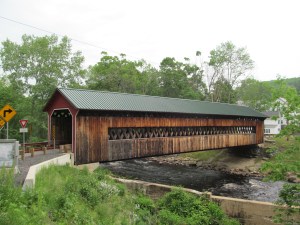 performance center couldn’t be found. “The Center is a place to celebrate the culture of Central Massachusetts and beyond. The Center provides a new venue for learning, creating, exhibiting, performing, and enjoying art.” (from the web page). Hardwick is a quiet, rural community of about 2,900 people. The town is half way between Amherst and Worcester, MA. Folks generally enjoy an agrarian lifestyle and reflect strong Yankee values of simplicity, harmony and balance with nature. Local offerings include a terrific
 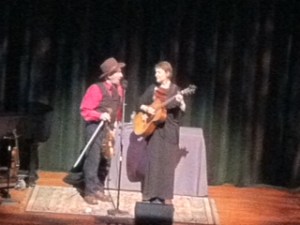 Jay and Molly are first superb musicians of fiddle, mandolin, guitar and piano. Jay has a confident, foot sure presence on the stage. He stands relaxed and straight with not a lot of movement in the body. He held the fiddle in a stance that gave all the energy and focus to the instrument. Indeed, the fiddle more rested on his left shoulder and upper arm rather than held away in a traditional violinist posture. His voice is dry and comforting to the ear. Actually Jay is approaching 70 years old and is perhaps giving his energy where it is most wanted now. Molly looked well and played strong. Several of her compositions were played including “Snowstorm”. They are a duo and complement each of their strengths. Their energy was comforting rather than energetic. They have been performing together for 40 years.
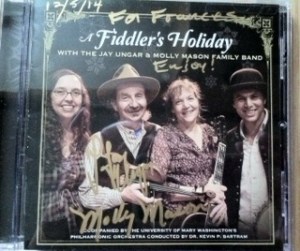 mentioned earlier, I had seen their daughter Ruthy (Ungar) and her husband Mike (Merenda), perform at this same theater in January. The faces on this CD are all of them in the order of Ruthy, Jay, Molly and Mike. When it was my turn to say hello, I mentioned having seen them years ago in Watertown. Molly had recollection of the stone structure of the Baptist Church. I was touched they could recall the night at all. Jay’s handshake was soft and warm. Molly’s was firm and cool. A blessing it was to touch the hands of these fine musicians. I went out into a messy, cold, slushy, rainy December night in Hardwick. I got home just fine and considered the rare privilege it had been to attend a performance by two of the finest American Acoustic Folk Artists of our Time. Jay and Molly.
 LuceStellare