by Frances Ann Wychorski
Charlton, MA
September 1, 2018
On September 3, in the year 1824, a party of four left Worcester, MA and traveled on the Worcester & Stafford Turnpike en route to Tolland, Connecticut. Upon reaching the Northside Village in the town of Charlton, they stopped at Wilson’s Coffee House for a meal and reception. The gentlemen in the horse-drawn carriage included Gilbert du Motier, known as Le Marquis de La Fayette, his son, Georges Washington, personal secretary André-Nicolas Levasseur and valet. President Madison invited La Fayette to return to the United States as the “Nation’s Guest” on the 50th anniversary of the signing of the Declaration of Independence. What was intended to be a four-month visit became a full year of celebrations as the retired Major General of the Continental Army traveled to all 24 of the United States. The entourage visited towns and cities along the way greeting local dignitaries, reviewing the militia and meeting old comrades from the battlefield.
On September 1, 2018, The Charlton Historical Society members celebrated the 194th anniversary of La Fayette’s visit with a full afternoon of activities. The event was ” Lafayette on the Stafford Turnpike; A Commemoration of Lafayette’s reception at the Rider Tavern on his farewell tour (1824-1825).” The tavern, home of the Society, held an open house allowing visitors to tour rooms on the first and second floor of the three floored structure.
The tavern is a landmark building on Stafford Street. It has had several owners but the original where the Rider brothers. As stated by William O. Hultgren in his book, “A Bicentennial History of the Rider Tavern 1797-1997”, it was built by, “distillery operators Eli Wheelock and Leonard Morey and opened by brothers Isaiah and William Rider in 1801.” The Rider Tavern is “one of the least altered and best documented example of a wayside inn of the Federal Period in New England.” The Society acquired the tavern in 1975-76 and began extensive restoration of the interior and exterior. Renovations were completed in 1982. The building is 90 feet long and 30 feet wide. The Italianate style entryways give it a distinctive look of style rather than substance. It sits back on the road with its tall windows glinting in the afternoon sun. The sage green painted exterior gives it an organic appearance.
Society Treasurer, Cindy Copper led twenty-minute guided tours through the house beginning in the restored barroom. In one corner of the room was a carrier filled with cutlery for the diners. Guests followed into the La Fayette dining room on the northeast side of the house. A table was set with period cutlery and plate in preparation for the meal later in the day. The room is well proportioned and returned to its 1824 appearance. In 1983, an Eagle Scout helped reattach the plastered ceiling to the lathe and removed layers of paint on the woodwork. The wallpaper was chosen based on research done at a similar house in Portsmouth N.H. The restoration work throughout the tavern reflects what would have been the norm at the time. The room is lovely to be in. On this warm late summer day, it was cool. The sea green woodwork is complimented by a white and green patterned wallpaper. The fireplace mantle and doors have white accented borders and striping giving it beauty and simplicity in artistic design. The black and white diamond pattern oil cloth floor covering was reproduced by a society member, as stated by Hultgren.
The tour continues through an upstairs ballroom that spans two-thirds of the second floor. The detailed stencil work around the doorways and walls give it flair. Copper told the audience, that itinerant painters would travel through towns and complete the work. The building has a function, but we see a turn to artistic expression all around the building. The coral colored plaster walls make the room feel large but friendly to be in. This space would have been used for public lectures and festive dances. The floors and walls betray an aged warp to the wood, but all is sturdy and comfortable under foot.
Visitors are led into receiving rooms, bedrooms, kitchens, parlors and stairwells. A display case on the 2nd floor landing contains artifacts of glass, chinaware and tools found during site excavations. Portraits of prominent men in Charlton’s past are placed on the walls with Copper providing brief recounts of their contribution to local history. The detail of restoration is impressive in the widow’s bedroom with hand-woven rush matting on the floors. A rope bed with its tool necessary for nightly tightening before retiring. The extensive stencil work on the walls is restored to period design. The color combination in this room of powder blue woodwork, dove grey floor, pale green plaster walls with green leaf motifs, curved lines and natural garden colors is relaxing and pleasing to the eye. A small cattail within the stencil wall motif picks up the fawn tan of the floor covering. The painter brought balance to the room with the chosen color palette.
The tavern benefits from natural light pouring through tall windows along all sides of the structure. The ceilings are ten feet high and rooms are well proportioned. This was built to accommodate the public in large and small parties. The tavern has something to offer in every room. It carefully preservers history and knowledge of life in an American inn of its day.
The event moved across the road into the preserved militia lot used for muster drills in the time of La Fayette. Society President, Frank Morrill, addressed a large crowd of 150+ people spread out around the grassy field surrounded by dry mortar stone walls. The audience included members from the American Friends of Lafayette, on a two-day tour of central MA. Several WWII veterans, including Horace “Bud” Holland from New Hampshire, that had fought in Normandy and France were present. The Grand Master of the Masons Lodge of Massachusetts, Paul Fulton Gleason, sent a letter to be read during the ceremony. Gleason reminded us that La Fayette had been a Freemason and was in Charlestown MA on June 7, 1825 for laying the cornerstone at the Bunker Hill Monument.
State Senator Anne Gobi told the crowd “that his was the only bust of a foreigner in the State House.” Gobi mentioned the Lafayette Trail Project and the goal of herself and State Representative Peter Durant in seeking funding to support this joint venture with France. According to the web page for the Consulate General of France in Boston, “French historian and geographer Julien Icher, who manages the Lafayette Trail Project, has been traveling throughout New England, researching and documenting each of Lafayette’s steps, focusing specifically on the major landmarks Lafayette visited, the local people he knew from his service during the Revolutionary War, and the various plaques and memorials to honor his visit.” Icher attended the event and briefly addressed the crowd stating plans for today’s activities began one year ago.
Ben Goldman, an actor with the American Historical Theater portrayed La Fayette during the reenactment. He arrived at about four o ‘clock in the afternoon as did the real La Fayette so long ago. A flutter went through the crowd as he walked along Stafford Street, greeting citizens and entering the field as guest of honor. He was dressed in Colonial attire with fine leather shoes, a crest on the hose, brick-red breeches, a gold waistcoat, finely sewn light wool matching frock coat, silk cravat and black tricorn hat. The ceremony began with Reverend James Chase reading the same invocation given by Reverend Rich during La Fayette’s 1824 visit.
Gilbert du Motier (1757-1834) was born in Chavaniac, France. The noble family has a history of military service to the monarchy dating back to the time of Joan of Arc. At the age of 19, La Fayette saw an opportunity to continue this tradition by becoming part of the American cause. General George Washington pressed him into military service at the 1777 Battle of Brandywine Creek in Pennsylvania. La Fayette took a musket ball to the thigh but managed to stay on his feet and rally soldiers into an organized retreat to a safer location. As La Fayette proved his ability to command troops, Washington eventually presented him a field commission as Major General to an entire division. La Fayette continued as a soldier and leader reaching the fateful 1781 Battle at Yorktown Virginia where General Lord Cornwallis surrendered after a twenty day siege by the French Navy at sea and American and French forces on the land.
La Fayette (Goldman) spoke to the crowd retelling the events of that day 237 years ago. “When the English were made to surrender at Yorktown, they were made to walk betwixt the two sides of American and French soldiers. ” The English would only look at the French, “they did not want to acknowledge that they had been defeated by an alliance which included upstart colonists which had so recently been their subjects.” Not satisfied with the conduct of the English, La Fayette asked the musicians to play a tune that in its time, was popular but used to taunt the colonials. He sang the familiar notes of “Yankee Doodle” to the crowd. It was the playing of this tune that managed to turn the heads of the English and look at the American forces. La Fayette spoke in French to the audience, thanking the patriots of Massachusetts for their hospitality. His journey now must continue, but the afternoon had been a great pleasure.
Upon news of his death, John Quincy Adams is attributed to have said of La Fayette in an address to Congress, December 31, 1834, “He devoted himself, his life, his fortune, his hereditary honors, his towering ambition, his splendid hopes, all to the cause of liberty. He came to another hemisphere to defend her. He became one of the most effective champions of our Independence; but, that once achieved, he returned to his own country, and thenceforward took no part in the controversies which have divided us.”
The reenactment reminded the audience of the support King Louis XVI of France gave to the United States at a critical moment during the Revolutionary War. France provided soldiers, commanders, arms and war ships to our cause. The World War II veterans in the audience reminded us of the favor returned helping France’s efforts toward liberation from German occupation. La Fayette said, “the success of the revolution was inextricably linked to the well-being of all people in all nations.”
The Charlton Historical Society members fulfilled their mission to “perpetuate the memory and spirit of the men and women who have made such contributions to the history and development of Charlton, as to render them worthy of recognition.”
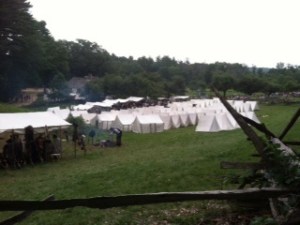 Camp is too small a word to describe the row upon row of neatly pitched tents covering every patch of Village ground. The British camp spread out over the common. I was astonished to find that the women and children of married soldiers, had come along and set up “home” away from home. As I arrived early in the morning, the cook fires were going with familiar fragrances. I stopped by the Towne House and spoke with a women frying doughnuts in a kettle. They were Loyalists from Maine in support of their men in arms. Apparently, it was not uncommon an occurrence and the source of comfort, nourishment and care for the soldier. And, should the soldier happen to die in battle, an opportunity for the widow to move on and remarry another soldier for the support and comfort of a husband and father to her children. There was an army surgeon, dentist and recruitment table for young men in search of adventure. There were drills, arms inspections, talks and even a quiet morning cup of tea.
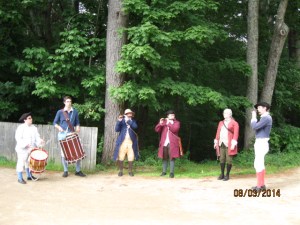 Fife and drum could be heard all the day long throughout the Village in militia units from many New England towns including Stow, MA and Lebanon CT. The British and Rebel camps daily activities are dependent on the drummers cue. The fife, drum and bugle are the “clocks” for the encampment and have a song for everything from wake up to wash, breakfast to battle. Several militia groups seemed to play just for the beauty of the music. The fife held a special significance in the battles and was the signal source for those big guns on the hillside. The sergeant-at-arms assured me that in the pitch and vigor of a roaring artillery barrage, the high tone of the fife could be heard above it all and signaled the unit officers what to do next in the battle.
 The Revolution came alive before my eyes. There were scores of men in every type of uniform on both sides moving through the Village. For the British there were Butler’s Rangers, a British Intelligence unit with Indian Scout, the Scottish Highland Regiment, Royal Irish Artillery, etc.
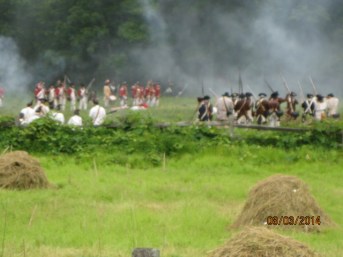
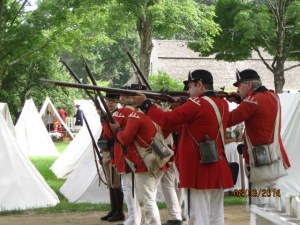 The hourly events included a skirmish in the lane near the Potter’s shed and kiln at around 11 a.m. As it was my first time at such an encampment it was a bit confusing about what or when it was to happen. I was caught by surprise and found myself at the edge of the skirmish as the Redcoats and Rebels went at it. The ferocity of the musket fire and veil of smoke covered everyone over. Here was a chance to watch men in earnest becoming soldiers of the day. The men are not merely “playing soldier” in an adult manner. They are reliving the steps and activities of our ancestors so that we may know what happened and what it was like to be a Patriot and soldier in the day.
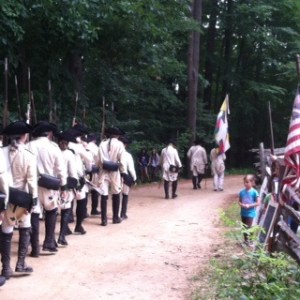 The early afternoon brought the event of the day with a fully engaged battle between the two camps. I fell in line behind the squadron of French soldiers as they marched out of the town and into the fields. After a lengthy tactical discussion, each unit set out to take up positions to fight the British. The battle began with an exchange of cannon fire on both sides. The open fields are bordered by forest and out of the woods came several units of Patriots forming a half-moon shaped arc of fighters around the British forces out in the open.
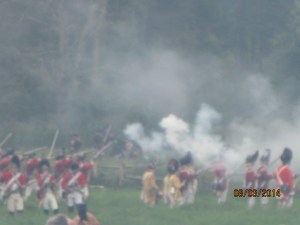 The ammunition, of course were blanks, no rounds were in the carbines or canons. The fields were littered with gunpowder packets from each shot. At no time did the call to fix bayonets go out. There was no hand to hand combat on the field. However, the movement and energy of the battle was fascinating. The element of fear was not present as it is a mock battle. The action was authentic and carried out with precision on both sides. There were hundreds of fighters on both sides. Spectators watched from the hillsides around the fields and were very close to the action. We could see the battle and sometimes wonder which way things would turn. The outcome is obvious but authentically presented.
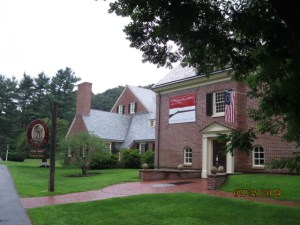 Without hesitation, it can be said that no other town in Massachusetts can boast of being the remarkable birthplace to both the Revolutionary War and the resting place of Transcendentalism.
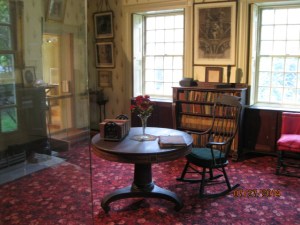 Emerson’s Study
 From the Concord Museum:
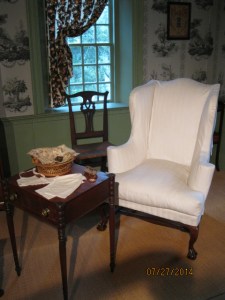 Early and Mid-1700s Rooms ~ 1800s Bed Chamber & Dining Parlor
 If the traveler comes by Concord, a stop at the Concord Museum is to be penciled in for the day. This is a not to be missed opportunity. The special exhibit is on display through September 21, 2014.
 LuceStellare