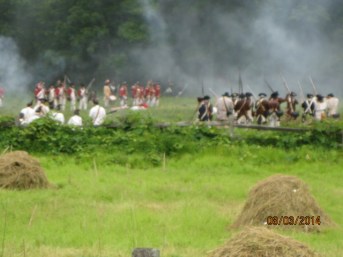
The lazy warm fields of the Freeman Farm in Sturbridge MA were transformed on the afternoon of August 3, 2014 into a busy battleground between the Redcoats and the Continental Army of 1776. Some 1,000 men, women and children from Canada to Pennsylvania gathered at the Old Sturbridge Village (OSV), Living History Museum for the largest American Revolutionary War reenactment in the Northeast. This was the 11th annual encampment held at OSV. Long fascinated by the history of Massachusetts Bay Colony, I set this day aside for the event. Here was a chance for acquired knowledge of the Revolution to become visual living knowledge in a unique format. Little did I know how grand and immersing the experience would be. This was my first experience as a spectator in a reenactment camp and sure to not be the last.
OSV is a large, living history museum in Sturbridge MA. This is an entire preserved village from the 1830s. The structures include a Friends Meetinghouse, Parsonage, Towne Bank, Town Pound, Powder house, kiln, Bullard Tavern and more. The herb and kitchen gardens grow native and imported culinary and medicinal herbs of the era. The goats, chickens, sheep and oxen are a vital part of the village and farms. This is life as it was in a quiet town in Massachusetts. The Village spans some 200 acres and offers activities for every member of the family.
I was a staff member at the museum for several years and came to admire the costumed interpreters for their devotion to maintaining old crafts and learning how to live and work within our American history. The Village gardens, houses, barns, mills and walkways became an old friend as I am a great walker and spent many a happy lunch hour strolling along the meadows and lanes. I absorbed a fair amount of knowledge and whimsy about rural 1830s life simply by being there.
Camp
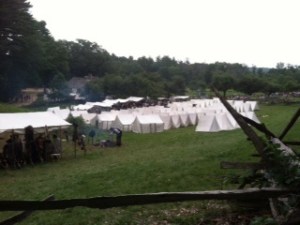 Camp is too small a word to describe the row upon row of neatly pitched tents covering every patch of Village ground. The British camp spread out over the common. I was astonished to find that the women and children of married soldiers, had come along and set up “home” away from home. As I arrived early in the morning, the cook fires were going with familiar fragrances. I stopped by the Towne House and spoke with a women frying doughnuts in a kettle. They were Loyalists from Maine in support of their men in arms. Apparently, it was not uncommon an occurrence and the source of comfort, nourishment and care for the soldier. And, should the soldier happen to die in battle, an opportunity for the widow to move on and remarry another soldier for the support and comfort of a husband and father to her children. There was an army surgeon, dentist and recruitment table for young men in search of adventure. There were drills, arms inspections, talks and even a quiet morning cup of tea.
Fife & Drum
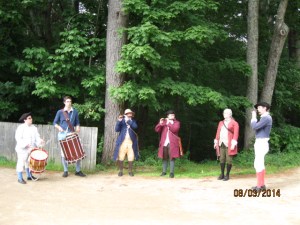 Fife and drum could be heard all the day long throughout the Village in militia units from many New England towns including Stow, MA and Lebanon CT. The British and Rebel camps daily activities are dependent on the drummers cue. The fife, drum and bugle are the “clocks” for the encampment and have a song for everything from wake up to wash, breakfast to battle. Several militia groups seemed to play just for the beauty of the music. The fife held a special significance in the battles and was the signal source for those big guns on the hillside. The sergeant-at-arms assured me that in the pitch and vigor of a roaring artillery barrage, the high tone of the fife could be heard above it all and signaled the unit officers what to do next in the battle.
Soldiers
 The Revolution came alive before my eyes. There were scores of men in every type of uniform on both sides moving through the Village. For the British there were Butler’s Rangers, a British Intelligence unit with Indian Scout, the Scottish Highland Regiment, Royal Irish Artillery, etc.
The Rebel or Patriot camp was located at the farther end of the village along the fields and farms of the Bixby and Freeman houses. A tour through the camp demonstrated the remarkable level of detail as to foods, table wear, cook pots, equipment, clothing, tents, weaponry, maps, lanterns and every bit of minutiae that was in use by the Continental Army of the day.
Even a French Regiment from Quebec province and Hessian Mercenaries were in attendance at this gathering of armies along the Quinebaug River.
A participant in these activities typically takes on the persona of a person who did serve in the Revolutionary War. The participant may have an ancestor who fought or kept a diary of activities associated with the time period. The majority of the current militia are formed from local towns. Someone became fascinated by the facts of their townsmen or women long gone, took on their story and made it live again. The person in history is researched and studied than put into action. The people who fought the revolution where everyday folks that found a compelling reason to take up arms against the British Crown. The anecdotal summary is that 1/3 of the population at the time of the war were Loyalists, 1/3 were Patriots and 1/3 were undecided.
Skirmish in the Woods
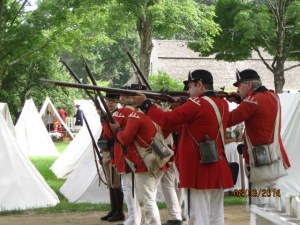 The hourly events included a skirmish in the lane near the Potter’s shed and kiln at around 11 a.m. As it was my first time at such an encampment it was a bit confusing about what or when it was to happen. I was caught by surprise and found myself at the edge of the skirmish as the Redcoats and Rebels went at it. The ferocity of the musket fire and veil of smoke covered everyone over. Here was a chance to watch men in earnest becoming soldiers of the day. The men are not merely “playing soldier” in an adult manner. They are reliving the steps and activities of our ancestors so that we may know what happened and what it was like to be a Patriot and soldier in the day.
The different styles of fighting was quickly discernible. The Rebels had a pattern of firing in waves with the first row shooting, moving to the back of the line to reload, the next row coming forward to fire and continue this wave as the battle moved on. The Rebels showed a habit of advancing the line with every barrage of musket fire. They steadily pushed at the British line creating momentum. Both sides held firm their ranks. The soldiers were shoulder to shoulder and did not break the lines despite the heavy gunfire all around. There was a moment of surprise as a Rebel unit came running up out of the woods behind the British line. They started firing into their backs and pinned the British forces to their position. They could not move but had to stand there and take the fire. This was deadly serious and gave me pause to understand how the war was fought. Because of the range of the muskets firing power, soldiers needed to be in close proximity to have any hope of striking their target. They were so close they could, pardon the cliché, see the whites of their eyes. At some point, the skirmish ended after about twenty minutes and both sides relinquished the fight.
The day went on with Artillery Fire (cannon), Musket Drills, and even a Sabers on Horseback demonstrations. On the lighter side there was Morning Service in the Meetinghouse, Camp Tours, Laundry duty, and even an 18th Century Social Dance.
Patriots Face Off Against the Redcoats
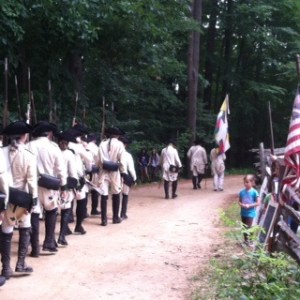 The early afternoon brought the event of the day with a fully engaged battle between the two camps. I fell in line behind the squadron of French soldiers as they marched out of the town and into the fields. After a lengthy tactical discussion, each unit set out to take up positions to fight the British. The battle began with an exchange of cannon fire on both sides. The open fields are bordered by forest and out of the woods came several units of Patriots forming a half-moon shaped arc of fighters around the British forces out in the open.
Once again, the style of fighting was distinct. The French fought hard with constant gunfire into the British line. As needs to be remembered, the Patriot forces are largely a self-taught militia lacking the discipline and precision of organized battle. They fought in the way that gave each man the least amount of exposure to enemy fire and allowed no pause in the action. The French forces stood out in contrast as being well seasoned professional soldiers. Viva La France. There was a distracting element to the combat as the British had to look in several directions at once to meet on-coming enemy fire. The Patriot forces came on in that wave formation of fire and fall back along the lane into the field proper. They fired, and fired until a blanket of gun smoke-filled the air. The cannons on both sides kept up a steady rain of artillery. What a scene! This went on and on for about a half hour. The tactic of advance and advance by the foot against the immobile British units was in action. To their credit, the British did not step back or give any ground.
At one point in the battle, both armies were in a long line firing directly at each other. Several British forces fell and fell some more. There were men on horseback, snipers in the woods, and cannons rolled deeper into the battle. A British officer with a plumed hat took that off and waved. This was taken to mean stop firing, we give this time.
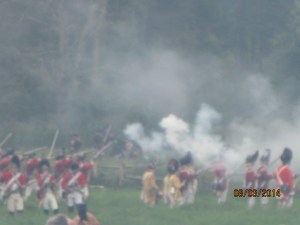 The ammunition, of course were blanks, no rounds were in the carbines or canons. The fields were littered with gunpowder packets from each shot. At no time did the call to fix bayonets go out. There was no hand to hand combat on the field. However, the movement and energy of the battle was fascinating. The element of fear was not present as it is a mock battle. The action was authentic and carried out with precision on both sides. There were hundreds of fighters on both sides. Spectators watched from the hillsides around the fields and were very close to the action. We could see the battle and sometimes wonder which way things would turn. The outcome is obvious but authentically presented.
Uncommon Courage
The encampment was a two (2) day event with evening activities as well. Time and opportunity restricted my visit to Sunday. The next experience will be much longer and more time spent talking to the participants and observing day-to-day life in a Revolutionary War Camp. I have little doubt that my fascination for the experience will turn from watcher to participant in the near future. I hail from Worcester and live in a small rural town that is thick with histories from both the French & Indian as well as Revolutionary War. There are plenty of local heroes small and large who are remembered to this day. Their bodies may have gone to rest, but the spirit of their courage has not been diminished with the years.
I came away with a sense of taking a great leap forward in acquired knowledge. Yes, the high school and colleges professors teach American history. Yes, we can visit Lexington and Concord to see Minutemen Park and the Old North Bridge. Yes, we can read and imagine the events of the Revolution. But, the participants to a person had more common and anecdotal knowledge of this time in American History. It’s one thing to have the facts, it’s yet another to act on them. The authenticity of clothing, weaponry and life style came through in each participant. These are modern-day Patriots. The Patriots of the day displayed uncommon courage and faith in what they took on. They believe in what they are doing and each other. The camaraderie amongst the troops and confidence of heart carried the day. For the short span of time I was with them it was a privilege to walk along side.
@FrancesWychorski2014
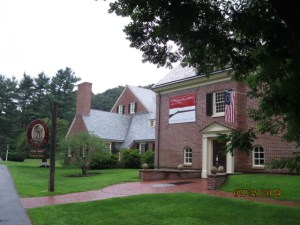 Without hesitation, it can be said that no other town in Massachusetts can boast of being the remarkable birthplace to both the Revolutionary War and the resting place of Transcendentalism.
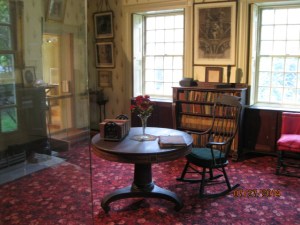 Emerson’s Study
 From the Concord Museum:
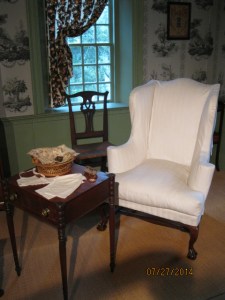 Early and Mid-1700s Rooms ~ 1800s Bed Chamber & Dining Parlor
 If the traveler comes by Concord, a stop at the Concord Museum is to be penciled in for the day. This is a not to be missed opportunity. The special exhibit is on display through September 21, 2014.
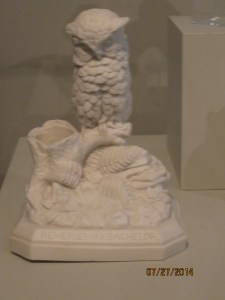 Reveries of a Bachelor (Lonely Owl)
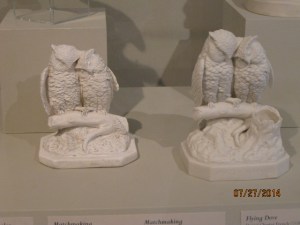 The pair read: Matchmaking
 LuceStellare