The Day I Became an American
 The definition of what it meant to be an American was a point of confusion as I was growing up. As a nation of immigrants, the majority of us can trace ancestry to a distant shore. The Native Americans may have a wholly different understanding of immigration with the disastrous outcome for an entire race of people. Newly arrived immigrants come here for the hope of a better life while coming to terms with what has been left behind. Truly, some may spend the remainder of their lives with a foot in both worlds. Immigrants as well as second, third and fourth generation Americans often apply a label to their identity in order to establish roots of ancestry. This is an important factor in socialization. Having been raised in a 2nd generation home, I can identify by association of place to being an American confused along with a thread of connection to the founding ancestry.
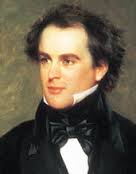
This article is about awakening and grounding into what it means to understand I am an American. Everything changed the day I read Nathanial Hawthorne’s Introduction to “Mosses from an Old Manse”, “The Author Makes the Reader Acquainted with His Abode”. A Collection of Short Stories published in 1846. It might have been the first time words on paper made such an impression. He spoke directly me in a prose of such beauty and depth that I melted into it. His presence come up off the page and spoke as if to me. He took me literally into his heart, home and to that place, our most sacred ground, where I became a full-blooded American.
Identity Obscured
I was born in the United States and have not moved too far from my home base of Massachusetts (MA). I am a 2nd generation American whose ancestors left Eastern Europe at the turn of the last century. My grandparents came here born out of a desire for adventure and change. Tired of living in a country that often times felt the boot of invaders trampling on to glory, they came to America for a better life.
I am from Worcester, MA. A place named for the sister city of Worcester, England and a Commonwealth named for the tribe that once lived here. We are descendant of British settlers landing at Plymouth in 1620. We keep the name of the original inhabitants alive. Really, it is difficult to not notice the pairing of English and Native American names side by side. In my area alone we have Quaboag, Podunk, Tantasqua, Wickaboag, Nipmuc, Hammonasset, Quinsigamond, etc… A foot in two worlds. Worcester was a manufacturing city and is notable for the inventiveness of Robert Goddard, anti-establishment rhetoric of Abby Hoffman and the Houdini of the Hardwood, Boston Celtic player Bob Cousy. I lived in a house with a small yard surrounded by smoking traffic, three decker’s and bustling immigrants. Worcester is known to be a gateway city. If there are people on the move, they may come here.
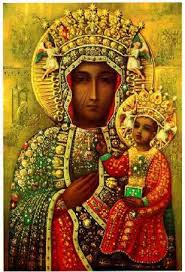 Worcester is a city of seven hills. The neighborhood I came from is referred to as Vernon Hill. In its day, the area was notable for its Americans descended from Polish and Lithuania immigrants. The foundation of the community is the Lady of Czestochowa Catholic Church. The imagery of Mary is strikingly different from the anglicized version. There are many legends associated with this portrait. She is a woman of beauty, youth, wealth and power. There is nothing passive about her. She would not be burned or lost to nonbelievers. A hint to the reader of how strong the identity to the motherland still is can be conveyed simply. In attendance at a funeral in this old church in 2013, in the vestry hangs a picture of Pope John Paul II. He died in 2005. He has been replaced by two (2) popes. Yet, this church still honors his ancestry and identifies with him through it. This is how strong the confusion can be to place of identity. The faith is based in a foreign church, not the American Catholic Church, but that of Poland.
The local markets cater to ethnic tastes. Worcester boasts several authentic markets well worth shopping in for Vietnamese, India, Mediterranean and Italian goods. The identity with where the ancestors came from is strong. I had early learning in Polish language and can still read a little. Apparently, I still speak with a slight accent as two people I recently met from Russia asked, where was I from? Rather than, you are an American. I was tied to Poland by my relatives, neighborhood, church and people around me. We all lived in this confusing place where identity to the old country came first often.
The Old Manse ~ The Author Makes the Reader Acquainted with His Abode
This may sound odd, but I did not realize I was an American first until my mid-thirties. I became fascinated with the writer, Nathaniel Hawthorne (1804 – 1864) formerly of Salem MA. He is a notable classic short story writer from the Transcendental Period (1820-1830) in American literature and famous for many writings including “House of Seven Gables”, “Rappuccini’s Daughter” and “The Scarlett Letter”. Based on reading his, “The Author Makes the Reader Acquainted with His Abode,” and particularly this
“The glimmering shadows, that lay half-asleep between the door of the house and the public highway, were a kind of spiritual medium, seen through which, the edifice had not quite the aspect of belonging to this material world.”
 I have never recovered from this sentence. He is describing the space between the street and front door of the old house. One does not simply walk to the front door, one passes through the veil between the worlds along the way. Hawthorne had a genius with lyrical prose. As a writer, he had a sensual, enveloping style of storytelling that wrapped the reader into his world and that of his characters.
He is my knight. And, I paid my respects. I visited the Old Manse in Concord MA within only a few days of reading this text. The beginnings of the War of Independence are visible from the backyard. There I was standing on the bridge and reading the plaque stating the significance of what happened here so many years ago. Standing on the battlefield, it seems outrageous that folks could have formed the notion of living without foreign rule and acted on it. The rebellion does seem to have been an extraordinary occurrence in the history of civilization. The fact that it succeeded is even more astonishing. There is a spirit about Concord that I found enlivening. The energy of independence is in the air. Here I realized I was a citizen of this nation and proud of it.
My parents and the community passed on a strange awareness of being here but from somewhere else. Because I was surrounded by other people who thought the same, I didn’t understand that I was leading a confusing existence until Concord. I lacked a personal connection with America as an American until that moment. Odd too, that I loved the Red Sox and spent many a happy hour at Fenway Park. I love the Boston Pops and have attended the July 4th celebration on the Charles River in Boston. Yet, I was confused by my allegiance. The sense of release from past prejudice has been a blessing.
Here is the description of the battlefield from Hawthorne, it lays only feet away from the Old Manse.
“Come; we have pursued a somewhat devious track, in our walk to the battle-ground. Here we are, at the point where the river was crossed by the old bridge, the possession of which was the immediate object of the contest. On the hither side, grow two or three elms, throwing a wide circumference of shade, but which must have been planted at some period within the threescore years and ten, that have passed since the battle-day. On the farther shore, overhung by a clump of elder-bushes, we discern the stone abutment of the bridge. Looking down into the river, I once discovered some heavy fragments of the timbers, all green with half-a-century’s growth of water-moss; for, during that length of time, the tramp of horses and human footsteps have ceased, along this ancient highway. The stream has here about the breadth of twenty strokes of a swimmer’s arm; a space not too wide, when the bullets were whistling across. Old people, who dwell hereabouts, will point out the very spots, on the western bank, where our countrymen fell down and died; and, on this side of the river, an obelisk of granite has grown up from the soil that was fertilized with British blood. The monument, not more than twenty feet in height, is such as it befitted the inhabitants of a village to erect, in illustration of a matter of local interest, rather than what was suitable to commemorate an epoch of national history. Still, by the fathers of the village this famous deed was done; and their descendants might rightfully claim the privilege of building a memorial.
 A humbler token of the fight, yet a more interesting one than the granite obelisk, may be seen close under the stonewall, which separates the battle-ground from the precincts of the parsonage. It is the grave–marked by a small, moss-grown fragment of stone at the head, and another at the foot–the grave of two British soldiers, who were slain in the skirmish, and have ever since slept peacefully where Zechariah Brown and Thomas Davis buried them. Soon was their warfare ended;–a weary night-march from Boston–a rattling volley of musketry across the river;–and then these many years of rest! In the long procession of slain invaders, who passed into eternity from the battle-fields of the Revolution, these two nameless soldiers led the way.”
These are my stories of old. I am of this heritage and while I may carry remnants of the old world in my name and manner, I honor that past, but prefer to live in this present at home. In this, the only home I’ve ever known.
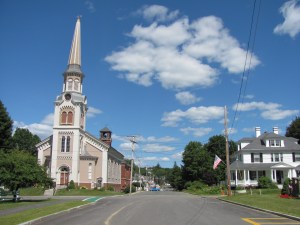 Brookfield is a small town in central Massachusetts nestled along the banks of the Quaboag River. Established in 1660, it was once part of the Quaboag Plantation, an area settled by colonists that migrated inland from the coastal community of Ipswich. Six towns emerged from that settlement including North, East, and West Brookfield, Warren, and New Braintree. Travelers driving on Route 9 from the Berkshires may pass through Brookfield on the way to Boston. Folks could read the news in the local weekly Quaboag Current or Spencer New Leader. However, Brookfield residents have an alternative press in the home-grown monthly “The Brookfield Citizen.” The publisher is APPLE Seed Inc. an acronym for Average People Promoting a Loving Environment. The monthly publication has become part of the fabric of life.
 “The Brookfield Citizen” has a staff of eight regular columnists and contributors. The topics include gardening, hunting, recipes, Selectman’s response, senior news, sports, and news from the Fire Chief, Highway, and Water Departments. The Look Back page features articles from 50 to 100 years ago taken from the archives of the Brookfield Times or Spencer Leader. The current issue even managed to squeeze in a cartoon. The publication is intended to be the “good news of Brookfield” and purposefully keeps the storyline up beat and entertaining. The police logs, obituaries and “hard news” are for the Quaboag Current and Spencer New Leader to cover.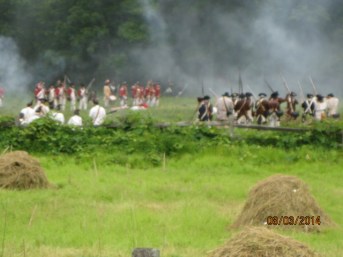
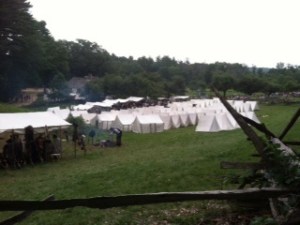 Camp is too small a word to describe the row upon row of neatly pitched tents covering every patch of Village ground. The British camp spread out over the common. I was astonished to find that the women and children of married soldiers, had come along and set up “home” away from home. As I arrived early in the morning, the cook fires were going with familiar fragrances. I stopped by the Towne House and spoke with a women frying doughnuts in a kettle. They were Loyalists from Maine in support of their men in arms. Apparently, it was not uncommon an occurrence and the source of comfort, nourishment and care for the soldier. And, should the soldier happen to die in battle, an opportunity for the widow to move on and remarry another soldier for the support and comfort of a husband and father to her children. There was an army surgeon, dentist and recruitment table for young men in search of adventure. There were drills, arms inspections, talks and even a quiet morning cup of tea.
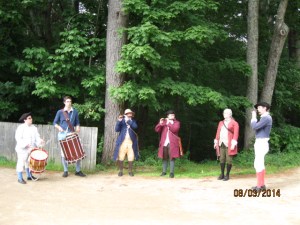 Fife and drum could be heard all the day long throughout the Village in militia units from many New England towns including Stow, MA and Lebanon CT. The British and Rebel camps daily activities are dependent on the drummers cue. The fife, drum and bugle are the “clocks” for the encampment and have a song for everything from wake up to wash, breakfast to battle. Several militia groups seemed to play just for the beauty of the music. The fife held a special significance in the battles and was the signal source for those big guns on the hillside. The sergeant-at-arms assured me that in the pitch and vigor of a roaring artillery barrage, the high tone of the fife could be heard above it all and signaled the unit officers what to do next in the battle.
 The Revolution came alive before my eyes. There were scores of men in every type of uniform on both sides moving through the Village. For the British there were Butler’s Rangers, a British Intelligence unit with Indian Scout, the Scottish Highland Regiment, Royal Irish Artillery, etc.
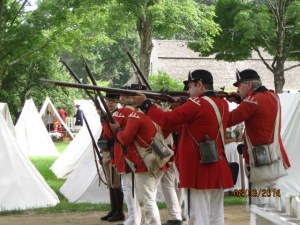 The hourly events included a skirmish in the lane near the Potter’s shed and kiln at around 11 a.m. As it was my first time at such an encampment it was a bit confusing about what or when it was to happen. I was caught by surprise and found myself at the edge of the skirmish as the Redcoats and Rebels went at it. The ferocity of the musket fire and veil of smoke covered everyone over. Here was a chance to watch men in earnest becoming soldiers of the day. The men are not merely “playing soldier” in an adult manner. They are reliving the steps and activities of our ancestors so that we may know what happened and what it was like to be a Patriot and soldier in the day.
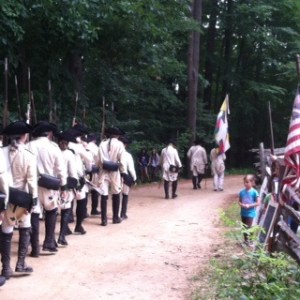 The early afternoon brought the event of the day with a fully engaged battle between the two camps. I fell in line behind the squadron of French soldiers as they marched out of the town and into the fields. After a lengthy tactical discussion, each unit set out to take up positions to fight the British. The battle began with an exchange of cannon fire on both sides. The open fields are bordered by forest and out of the woods came several units of Patriots forming a half-moon shaped arc of fighters around the British forces out in the open.
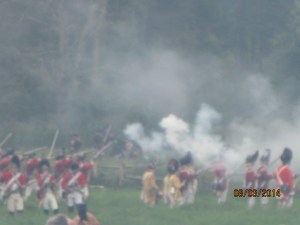 The ammunition, of course were blanks, no rounds were in the carbines or canons. The fields were littered with gunpowder packets from each shot. At no time did the call to fix bayonets go out. There was no hand to hand combat on the field. However, the movement and energy of the battle was fascinating. The element of fear was not present as it is a mock battle. The action was authentic and carried out with precision on both sides. There were hundreds of fighters on both sides. Spectators watched from the hillsides around the fields and were very close to the action. We could see the battle and sometimes wonder which way things would turn. The outcome is obvious but authentically presented.
 LuceStellare