Worcester, in the heart of the commonwealth, is Massachusetts’ second largest city. Worcester Public Library (WPL) at Salem Square in the downtown district provides services for 181,000 residents. Immigrants may take English language and citizenship classes. Entrepreneurs participate in small business workshops. There are book clubs for different generations of readers. History buffs and genealogists have access to maps, databases and records for Worcester County. The motto of the library is: Your Open Door to Opportunity. The privacy rights of all patrons are an integral part of daily service. When WPL automated materials check in and check out, it gained efficiencies and a deeper layer of security for patrons.
The decision to automate services at WPL is the result of collaboration between former Worcester City Manager Michael O’Brien, city councilors and former Library Director Wei Jeng-Chu. The automated materials handling service (AMH) was installed in April 2013. The Lyngsoe System AMH costs $320,000 and includes radio tags on materials. Danielle Mattei, circulation manager, said the former director called it “the Willy Wonka Machine.” Patrons return materials at the outdoor or indoor kiosk. The interactive keypad offers direction in English, Spanish, Vietnamese and Chinese. A scanner reads a barcode on materials placed in the drop off box and whisks it down a conveyor belt to the appropriate bin.
Head Librarian Geoffrey Dickinson is pleased with the speed of getting materials back out for loan. “WPL has an annual circulation in excess of 900,000 items per year,” said former Circulation Services Manager Anne White. “A returned item passed through many hands and several days before getting back on the shelves. Now everything is completed in less than a day…in August the average turnaround time was down to five hours.”
The check out provided by Bibliotheca Library Systems cost $135,470. Patrons activate the service with a library card and pin number. A scanner reads the barcode. A receipt shows only the name of the items loaned with a return date. There is no name or card number assigned. When the materials are returned, the information is deleted from the records. Any fines are noted on the receipt. The patron may also check material out at the staffed service desk near the kiosk. A librarian at WPL said patrons may want to refer to something previously loaned, but the information cannot be retrieved.
This feature of the drop off and check out systems protects the privacy of patrons. Both the Council of American Library and Association of Librarians strongly recommend “the names of library users to be confidential.” Why? “Intellectual freedom and the right to research can be preserved only if patron privacy is respected,” as stated in the Slate article, June 2015, by April Glaser, “Long Before Snowden, Librarians Were Anti-Surveillance Heroes.” The Patriot Act, passed in October 2001, gave the National Security Administration access to library records under Section 215. This provision expired in June 2015. While active, librarians could be subject to subpoena from FBI for patron records. Librarians were prohibited from telling patrons about the records request. Therefore, the actual number of requests is unknown. In 2005, a library in Bridgeport Connecticut received a national security letter from the FBI for patron data. The library staff “filed a brief in the Supreme Court to challenge the Patriot Act,” said Glaser. In September 2007, U.S. District Judge Victor Marrero heard the case and found the entire national security letter provision of the Patriot Act was unconstitutional. “In October 2001, a University of Illinois survey found that 85 libraries had been contacted with government requests.” The American Library Association released a survey in June 2015 showing that law enforcement officials had contacted libraries at least 200 times since 2001 with formal and informal inquiries about their internal records, Eric Lichtblau wrote in The New York Times.
WPL Privacy Policy “champions the protection of personal privacy.” If a subpoena or letter is served on the library, hoops have to be navigated before data is released. The librarian contacts the City of Worcester Law Department to determine if procedure has been followed. If confirmed, the Board of Directors are notified before the library will comply with the request. This also applies to public searches for information in the library online search catalog and public computers. Within 48 hours, the automated systems wipe the records clean of activity. The FBI and other authorities may want to know what patrons are accessing but at WPL it is almost impossible.
The installation of the automated system did not cause any job loss, Mattei said. In fact, because of the efficiency, Bookmobile city service has expanded. Two libraries on wheels, Libby and Lilly, provide monthly services to retirement homes, community centers and several private and public schools without libraries or librarians on staff. Efficiency in automation also allows the Library to fulfill its goal of maintaining five branches in Worcester. “The WPL is a community center not just for books but technology providing 24 hour service on-line. Technology enhances service, it does not replace it,” said Mattei.
Baskets have been part of households for thousands of years. When they came into use is difficult to know. Pottery, intact or in shards, can be dated by archeologists. Baskets, made of natural fibers, decayed long ago. A basket is made by intertwining material in a specific pattern. A deceptively simple design that holds itself together by the weave. The idea may have come from birds. The nest is a circle of grasses and mud woven together by a beak with instincts as a guide. The placement is so wise, it takes the strongest winds to knock them out of trees. Nests seem delicate yet are strong, as are baskets. There are many styles, techniques and materials for weaving. The uses are limitless from holding eggs to people in a hot air balloon as it floats up into the sky. Basket makers, also called weavers, carry forward a handcraft that connects us through the centuries from our humblest beginnings into modern times. The craft is alive and well in safe hands.
Sandy Salada, a basket maker in Latham NY, said baskets were made first by Native Americans. “They were made out of reeds and sewn together. The materials used include sweet grass, palm leaves, and long pine needles. The coiling method is the oldest style. Some are so tightly sewn they can hold liquid without any seepage through the weave. They were made simply because of needing something to hold things.” The tradition of basket weaving is more popular in the American South. Salada is one of few teachers advertising workshops in the Northeast for the next generation of basket makers. Salada, a graduate of Mercyhurst University with a major in Art Education, started weaving twenty years ago. She teaches at her home studio, and a variety of locations around Albany. “Once you make a basket, you can understand what goes into it, especially the quality of the material and design. All are hand made no matter where they come from. Anyone from 10 to 70 years old can be taught. Some can make baskets, but few can teach. A good teacher has to have a passion for the craft, it’s not a job, its passing on a tradition.”
Claire Williams, a costumed staff member at Old Sturbridge Village Living History Museum (OSV), learned the craft from a friend 35 years ago. OSV is a complete preserved working town from farm field to Parsons House in Sturbridge, Massachusetts. The village depicts life as it was in the 1830s. Williams “always has one going.” The basket is an intricate puzzle made from oak and ash tree splints, cattail leaves, reeds, or grasses. This material is known as the weaver. The dimensions and design are measured before a basket is started. The base is the most complex part as it must join the spokes around which the weaver is laced. The spokes are the skeleton of the basket. The handle is made from different woods and carved or steamed into its shape. The handle slides into the weaver and is notched into the rim. The rim is lashed on with twine. The finished piece has a stable base, is sturdy, balanced, lightweight and can last for years. Where the weave starts and new material is added as it is being constructed is hard to distinguish. It appears as one seamless piece. Depending on the complexity of the design, it may take from two to ten hours to complete.
Williams said that in the early days of settlement in Massachusetts, Native American women sold and repaired baskets in the towns. The most popular material is black ash. Willow, ash or reed come from a variety of places and countries. A few traditional crafters know how to harvest the tree and create the weavers. The felled ash tree is soaked in a pond for three months, taken out, debarked, and pounded with a mallet. The softened wood comes apart at the growth rings. These strips of wood are the weavers. The process can take five months to complete.
Williams said that, “I always thought it was a beautiful craft, an art, but something useful all the same. They are not just for décor. It’s an art form that should not be forgotten or lost.” Williams makes her own dye out of black walnut using a dilution of water to get just the right patina on the basket. Her most favorite one is the “cradle made for my first grandson Jacob. His name was etched into the wicker along with his brother Caleb’s a few years later.” She has a vibrant air. Her hands are surprisingly soft matching her expression of contentment with life as it is. “Weaving is very satisfying, relaxing. I enjoy knowing that what is done is a natural, useful product.”
Williams is happiest when able to be close to nature. Originally, from Putnam Connecticut, she married a dairy farmer from nearby Pomfret and worked at a sawmill in the business office. She raised one daughter and in retirement, volunteers in the rural environment of the living history museum. She does not consider basket making a chore but a way of life. “It’s a fulfilling past time. There is nothing better than to be weaving a basket on a stormy day. Puts me in a mood, so relaxing to watch the snow fly.”
Along the Quaboag River, on the western edge of Worcester County, travelers on Route 9 pass by Howard’s Drive-In, Honey Bee Orchards, down the hill and over Coy’s Brook into the Historic Center District of West Brookfield Massachusetts. The five acre tear drop shaped common fans out to a panoramic view of 204 houses, barns, outbuildings, stores, a Town Hall, Public Library, tavern, seminary and three churches. The common is one of the best preserved in Worcester County. A baseball diamond at the east end has felt the slide of generations of sneakers. The Rice Memorial Fountain water nymphs refresh weary walkers with their gentle spray. Every July 4th, an evening bonfire is lit in celebration of life in a small New England town. Over by the Congregational Church with its classic meetinghouse spire, is a three-storied stick style towered Victorian known as Windemere House. On the west side of Main Street stands another Victorian. Forsaken five years ago, it stood cold and estranged with no light shining from within. Now, the wheel of fortune has spun and the grand house is coming back to life. There is activity in the courtyard. Commuters slow down to check on the daily progress. Neighbors pause to reminisce on what it was and what it might be. West Brookfield welcomes the return of the Envy House. Chuck Atkins and Gregory Morse of Worcester are the new owners of Fales Mansion.
George Fales Photo provided by Bill Jenkins
George H. Fales (1834-1903) built his Victorian in 1873. It was designed by architect W.G. Preston of Boston. Preston had commissions in Massachusetts, New York, Rhode Island and Georgia. His collected works include 10,000 municipal building and private home designs. Preston’s constructions include MIT’s Rogers Building, John Hancock Building on Devonshire Street Boston and Jacob Sleeper Hall at Boston University. Fales inherited a profitable shoe manufacturing business and was active in town governance. He had a flair for business and owned a large amount of property in town. He loved music and played the organ for the Congregational Church for 50 years. His daughter Charlotte (1871-1971), “Lottie,” continued for 50 more. Fales married Laurinda Tomblen in 1864. Her brother John built Windemere in 1880 with the intent to rival the grandeur of Fales hence the name Envy. The competition was between the sisters-in-law to own the most stylish residence in town. Both houses are designed to be big and bold. They are private homes that fill the eye by their sheer size, both being over 4,000 square feet, two stories with a dramatic corner tower adding an additional story. Windemere is in good condition and now a doctor’s office.
The Fales Mansion was sold out of the family 40 years ago. His son John died after one year of life. The eldest daughter Mary Ilione, married Samuel Wass, their son George inherited the estate after Lottie died. Trudy died at four. Lottie never married. Marguerite had a childless marriage. Of Georgie Belle, little could be found about her life although she lived to the age of 85 dying in 1962. In the 1980s, it became The Brookfield House restaurant. It has been the scene of a contentious divorce or two and almost lost in a fire. How could any house reach the great age of 142 without a few skeletons in the closet.
Old houses “are important members of the community and embody the physical history of the town” said Susan Ceccaci of Preservation Worcester. “They are a landmark and part of the townscape, if torn down, would interrupt the streetscape and leave a large hole in the environment. It’s far easier to remember and understand history when something is physically still there.” The challenge for residents will be the concept of the house as part of the town’s history but a private home. A previous owner commented that every two weeks, a stranger would knock on the door and ask to see inside. The house has been unoccupied for five years. People have been pilfering perennial plantings from the front yard. Folks walk around the property taking pictures as if it were a public space. There is a fine line between curious and intrusive. The house was built to be seen and enjoyed for its magnificence. When an old house acquires a new owner, the collective historic significance and character come along as well.
Edward Gordon, President of the New England Chapter of the Victorian Society, described the Fales house as “a stylistically eclectic example of a mid-nineteenth century country mansion. Victorian is an umbrella term that over arches the many architectural styles that fall within the period of 1837-1901–the years of Queen Victoria’s reign–with that said the primary style is Mansard as seen in the roof configuration–in this case it is a hip-on-mansard roof. The Mansard Style has its roots in French architecture going back to the late 17th century and then revisited in Napoleon III’s France during the 1850s and 1860s. The Mansard’s double pitched roof was part attic and full top floor and was where servants, storage and even billiard rooms were placed (in the last case in American city houses)
The corner tower component at right has a roof with circular or occulus windows which are frequently used in conjunction with mansard roofs. There is also evidence of the Italianate style as seen in the arched first floor windows of the conical-roofed structural component at left as well as the bracketed and cornice-headed lintels of some of the first floor windows. The Italianate Style was popular in the US from around 1850 until the 1870s and persisted as a “go-to” style in certain neighborhoods and towns until as late as the mid 1880s. The house is also Stick Style referenced in the porch roof and dormer windows–more specifically the angled bracing that extends from the porch posts to the roof as well as the saw-cut kingpost which is evident within the triangular configuration that is at the center, above the porch entrance as well as at the center of the dormers.”
Each window facing the street has a dormer with spire and extensive stick work. The corner dormer frames have fan shaped braces and stenciled design. There are five steps up to the double entry golden oak front doors and stick style porch with eleven stars stenciled into the overhang on the front and six on each side. The left parlor although appearing to be square on the outside, is actually a perfect pentagon of five walls. At the top of each wall is a cornice creating a shadow effect around the room. On the ceiling is a perfect band of crown molding in the same pentagon matching the wall cornices. The fireplace surround is intact. The main staircase is a solid straight rise, but the back staircase on the west side of the house is the showstopper with an S-curve oak banister. The arced tread and risers are built into the back wall and follow that exquisite S all the way to the top. It resembles a staircase inside a lighthouse. The quality is stunning. “The wood work displays craftsmanship and preserves the hand of man in design,”said Ceccaci. The morning room windows are six feet tall. The ceilings in the main house rise 12 and 15 feet in the kitchen. There are six bedrooms, a music and flower room. The corner tower is also a pentagon and built southeast to catch the rising sun.
Preservation of houses tends to be up to the individual owners. Gordon said, “New England is big on preserving its Colonial and Federal architectural legacy. Victorian design has always taken a back seat in this region despite the fact that so many cities and towns have spectacular examples from that period.” The National Historic Preservation Act was enacted only fifty years ago. The National Register of Historic Places may preserve the space, but funding is likely to be out-of-pocket for restoration. Historic Preservation consultant, Jen Doherty said it is cheaper to build new as what may look remarkable on the outside, can have invisible things that stop progress.
The house served as the residence of “The Mystic Phyles” character Abigail Thaddeus in 2011. Stephanie Brockway and Ralph Masiello, author and illustrator lived there from 2003 to 2010. Masiello said the house has “great bones.” The frame is made of solid chestnut. The interior woodwork is black walnut and oak. The pocket doors slide effortlessly. There is no warp or sag to the structure. The doorknobs are made of mercury glass. Previous owners pilfered the mansion selling chandeliers, fireplace mantels, antique baby carriages and furniture to pay the mortgage. Masiello wanted to add the house to the National Register of Historic places. But, they lost it to the Great Recession of 2008. Masiello hosted Halloween open house and skating parties in the courtyard. He meant the house to be open and a public place to be celebrated.
The new owners will be an object of curiosity because of the houses value as a historic member of the West Brookfield community. The grapevine has a figure of $300,000 to $500,000 for renovations. The mild November weather has permitted an exterior painting of four, not five colors. The body of the house is sage green, the trim are oyster white, soft fawn and nutmeg brown. The dove grey slate is going up on the roof. Will the tower once again wear a golden coronet? The best reason for conservation of old houses may be the sentimental value alone. Ceccaci said, “They serve the role of connecting generations of inhabitants.” The oral history is shared with those eager to soak it in.
Conservation and preservation are not a new concern to the history of the town. An article from the Spencer Sun, May 25, 1877 talks about progress coming to West Brookfield in the addition of concrete sidewalks and the loss of a pine tree near the Fales House. “The old pine tree, about the largest in town, near the residence of George Fales, Esq, has gone, root and branch. It was almost 175 years of age….Many an old landmark has been removed in our village within a few weeks.” It took five horses to pull up the roots of the old tree. Something important was lost that day. “Woodman, spare that tree. But does it not show a spirit of vandalism that the act has been committed and that many a noble and aged tree has been cut down.” The loss of trees lamented so long ago. The pine would have been planted around early 1700, it may have seen the passage of the Nipmuc on the way to the winter camp at the area now known as Rock House Reservation. The early settlers establishing Ye Olde Tavern as a way station between Springfield and Marlboro. George Washington make his ceremonial pass through the area in 1789.
Local historian, William Jankins, cut the grass at the Fales Mansion as a young boy and recalls Lottie and her sister Marguerite as demanding old ladies. Lottie died in 1971, just shy of her 100th birthday. He remembered a formal Victorian garden. There was a porch on the east side of the house with a large exterior box off the kitchen with a locked outer door. The key was in the pocket of the local ice vendor. He never went in the house. Fales had shares in a private aquifer system that piped fresh water into the house from Long Hill Road. Jankins was born in a part of Greenwich and West Hardwick lost to the Quabbin Reservoir, the municipal water supply for the city of Boston, 76 years ago. John Tomblen’s wife, Mary Frances Shaw, was born in the submerged town of Prescott. He is a living link to places and people fading out of the collective memory.
An October posting with photo from the 1980s on the West Brookfield Facebook public group page keeps rising up to the top with 149 likes and 74 comments including several from the new owner Chuck Atkins. The comments are fragments of history. Atkins said it would be a private home and hopefully ready in time for next year’s Halloween. His partner, Gregory Morse, mentioned being contacted by the Quaboag Historical Society. The support of the community is for the preservation and celebration of what makes this town so historic. The most common request is what will the restoration be like? Atkins said, “I’ve been in love with the house since the fire, about 16 years ago. I’m thrilled to be able to restore it. It will be done right.”
@FrancesAnnWychorski2015
Acknowledgements
Windemere House
Heartfelt thanks to all those who helped in the writing of this story. The afternoon in the Jankins parlor was simply mesmerizing. His collection on the town was endless with maps, documents, postcards and photographs. When I walked out of his colonial farmhouse, I swam a little in confusion of what year it was. There was the common The meetinghouse spire against a cold grey November sky. Windemere House was sitting pretty on the corner.
Unfortunately, I could not find a photo of the Fales, only their final resting place in Pine Grove Cemetery. For all the opulence of the mansion, here was a relatively unadorned tombstone. Rest in peace George, Laurinda, Mary, John, Gertrude, Marguerite, Charlotte and Georgie Belle.
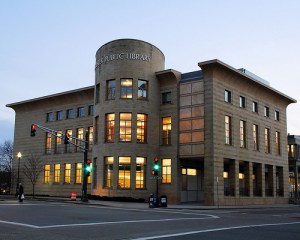 Worcester, in the heart of the commonwealth, is Massachusetts’ second largest city. Worcester Public Library (WPL) at Salem Square in the downtown district provides services for 181,000 residents. Immigrants may take English language and citizenship classes. Entrepreneurs participate in small business workshops. There are book clubs for different generations of readers. History buffs and genealogists have access to maps, databases and records for Worcester County. The motto of the library is: Your Open Door to Opportunity. The privacy rights of all patrons are an integral part of daily service. When WPL automated materials check in and check out, it gained efficiencies and a deeper layer of security for patrons.
 The installation of the automated system did not cause any job loss, Mattei said. In fact, because of the efficiency, Bookmobile city service has expanded. Two libraries on wheels, Libby and Lilly, provide monthly services to retirement homes, community centers and several private and public schools without libraries or librarians on staff. Efficiency in automation also allows the Library to fulfill its goal of maintaining five branches in Worcester. “The WPL is a community center not just for books but technology providing 24 hour service on-line. Technology enhances service, it does not replace it,” said Mattei.
 Baskets have been part of households for thousands of years. When they came into use is difficult to know. Pottery, intact or in shards, can be dated by archeologists. Baskets, made of natural fibers, decayed long ago. A basket is made by intertwining material in a specific pattern. A deceptively simple design that holds itself together by the weave. The idea may have come from birds. The nest is a circle of grasses and mud woven together by a beak with instincts as a guide. The placement is so wise, it takes the strongest winds to knock them out of trees. Nests seem delicate yet are strong, as are baskets. There are many styles, techniques and materials for weaving. The uses are limitless from holding eggs to people in a hot air balloon as it floats up into the sky. Basket makers, also called weavers, carry forward a handcraft that connects us through the centuries from our humblest beginnings into modern times. The craft is alive and well in safe hands.
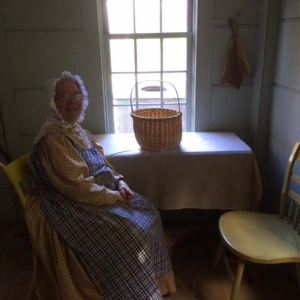 Claire Williams, a costumed staff member at Old Sturbridge Village Living History Museum (OSV), learned the craft from a friend 35 years ago. OSV is a complete preserved working town from farm field to Parsons House in Sturbridge, Massachusetts. The village depicts life as it was in the 1830s. Williams “always has one going.” The basket is an intricate puzzle made from oak and ash tree splints, cattail leaves, reeds, or grasses. This material is known as the weaver. The dimensions and design are measured before a basket is started. The base is the most complex part as it must join the spokes around which the weaver is laced. The spokes are the skeleton of the basket. The handle is made from different woods and carved or steamed into its shape. The handle slides into the weaver and is notched into the rim. The rim is lashed on with twine. The finished piece has a stable base, is sturdy, balanced, lightweight and can last for years. Where the weave starts and new material is added as it is being constructed is hard to distinguish. It appears as one seamless piece. Depending on the complexity of the design, it may take from two to ten hours to complete.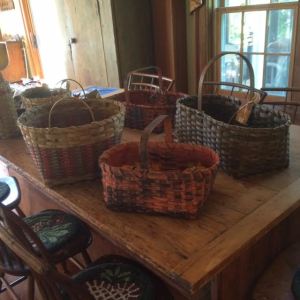
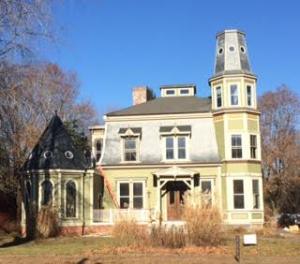 Along the Quaboag River, on the western edge of Worcester County, travelers on Route 9 pass by Howard’s Drive-In, Honey Bee Orchards, down the hill and over Coy’s Brook into the Historic Center District of West Brookfield Massachusetts. The five acre tear drop shaped common fans out to a panoramic view of 204 houses, barns, outbuildings, stores, a Town Hall, Public Library, tavern, seminary and three churches. The common is one of the best preserved in Worcester County. A baseball diamond at the east end has felt the slide of generations of sneakers. The Rice Memorial Fountain water nymphs refresh weary walkers with their gentle spray. Every July 4th, an evening bonfire is lit in celebration of life in a small New England town. Over by the Congregational Church with its classic meetinghouse spire, is a three-storied stick style towered Victorian known as Windemere House. On the west side of Main Street stands another Victorian. Forsaken five years ago, it stood cold and estranged with no light shining from within. Now, the wheel of fortune has spun and the grand house is coming back to life. There is activity in the courtyard. Commuters slow down to check on the daily progress. Neighbors pause to reminisce on what it was and what it might be. West Brookfield welcomes the return of the Envy House. Chuck Atkins and Gregory Morse of Worcester are the new owners of Fales Mansion.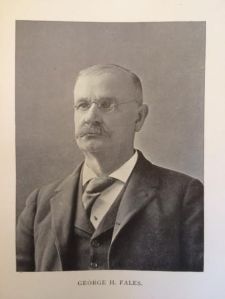
 The Fales Mansion was sold out of the family 40 years ago. His son John died after one year of life. The eldest daughter Mary Ilione, married Samuel Wass, their son George inherited the estate after Lottie died. Trudy died at four. Lottie never married. Marguerite had a childless marriage. Of Georgie Belle, little could be found about her life although she lived to the age of 85 dying in 1962. In the 1980s, it became The Brookfield House restaurant. It has been the scene of a contentious divorce or two and almost lost in a fire. How could any house reach the great age of 142 without a few skeletons in the closet.
 LuceStellare