Brookfield, MA – February 13, 2018
The Tobin’s Beach Site archeology study of Nipmuck burial grounds presented by Eric Johnson, Director of UMass Archaeological Services, Clarence Snyder, Brookfield Selectman and Thomas “Silver Fox” Morse of the Chaubungaungamaug Band of the Nipmuck Nation drew a standing room only crowd to the Town Hall. Field study results from May 2017 supported an application to list the site in the National Register of Historic Places. Johnson said it “has a 100% chance of being approved.” If it is, the site would be eligible for funding to protect and preserve the burial ground. Snyder said at the next Town Meeting, residents would be asked to vote on $15,000 to continue the project. The Massachusetts Historical Commission agreed to match the amount.
Johnson presented a “plain language report” for non-specialists on the current and future status of the site. This was the second in a series of informational public meetings on the area which encompasses the Upper Quaboag River and Quaboag Pond. The property is owned by the Town of Brookfield MA. In February 2017, Johnson gave a summary of what was known and what would be the goals of the field study. Johnson said, “The greater goal is the preservation of the site, returning artifacts and human remains to their descendants. This is a sacred place. “
According to the U Mass Archeological Services (UMAS) study, human remains were found in 1963 during the installation of a utility pipe near the campground owned by Mr. James Tobin. Brookfield resident Barker Keith, an amateur archeologist, was asked to investigate.
“An Adena-Connected Burial Site” by Keith was published in the Bulletin of the Massachusetts Archaeological Society October 1965. A red substance found in the pipe trench was determined to be red ochre “often deposited in graves here in Massachusetts.” The presence of red ochre at burial sites is an indication of an Adena cultural burial trait.
Keith describes the excavation of 14 burial sites at Tobin’ Beach removing artifacts and human remains from the graves. The objects, or “grave goods”, included spear points, tobacco pipes, knives, scrapers, shells and beads considered to be from the Adena heartland of the Ohio River Valley. He wrote that the Adena settlers arrived about A.D. 200 – 300. In his conclusion Keith said, “certain likenesses between Adena culture traits from these western areas and some of the recoveries from the Quaboag site are noticeable.” The Keith collection was donated to the Springfield Science Museum.
According to James Gage of Stone Structures of Northeastern U.S., “Scholars and archaeologists have been arguing about how far the Adena culture pushed into northeastern U.S. for decades. I suspect the new archaeological investigation at Brookfield will re-ignite that debate. The question will be whether the Brookfield represent an (a) actually Adena settlement, (b) Native American group influence by Adena culture through assimilation or marriage, (c) Native American group that acquired Adena artifacts through trade network.”
Johnson’s field study, paid for by a grant from the Massachusetts Historical Commission, focused on ascertaining if any undisturbed graves remain at the site. Local historians, newspaper accounts, maps, diagrams, and aerial photographs were studied for places to search. The fieldwork revealed “evidence that parts of the burial ground were still intact, and needed to be protected.” Soil discoloration revealed the location of rotted posts left in the ground, twenty food storage pits and evidence of a cooking fire. Fragments of pottery were also found in sifted soil. The study discovered, “Most importantly, in the area where Barker Keith had excavated, we observed two soil discolorations that in shape and size were consistent with burials he had excavated more than 50 years earlier.”
In consultation with the Nipmuck tribe, the next phase of the project is on how to secure the burial ground. An access road for residential emergency services needs to be installed without disturbing the remains. Long term plans include signage at the site and a potential Cultural Center for the region.
Tom “Silver Fox” Morse shared a moment of spiritual connection with the audience. Apparently, during a visit to the site, a member of the party experienced the sensation of sudden cold. The other members of the group observed his hair standing on end. A few steps and moments later, the air temperature and his reactions returned to normal. Perhaps the ancestors sent a message to the group on awareness of their presence at this most sacred place.
There are three upcoming planning sessions on the Tobin’s Beach site: February 27, 6:30 p.m. in Town Hall, March 3, 9:30 a.m. Brookfield Congregational Church and March 14, 6:30 p.m. in Town Hall.
Photo credits: The Boston Globe: Jill Zuckerman (left) and Alexander Honsinger (right) removed layers of topsoil.
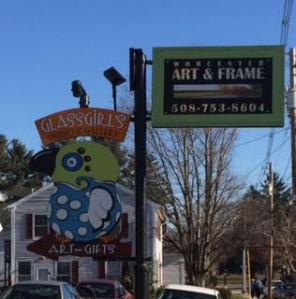 Glassgirl’s Studio & Gallery in downtown West Brookfield Massachusetts is a unique emporium. In an area noted for antiquing, the shop sells a funky collection of handmade jewelry, art prints, and contemporary gifts more common to touristy towns like Northampton or Nantucket. Proprietor Jennifer Geldard, an international glass bead and jewelry artist, says, “its an uber-cool place to stop.” The challenge is attracting customers in a sleepy little town of 3,000. After two years in her current location, she has established a local and regional following. But, don’t think old retail. The savvy merchant brings the buyer into the store the virtual way. The social media sites, Pinterest and Facebook, help a niche retailer reach regular and new clientele.
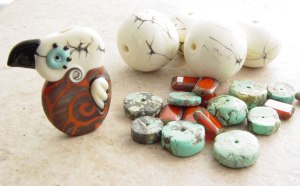 Geldard prefers to devote her time in studio to her art. “I am an artist, I don’t want to spend my energy trying to advertise my jewelry and art. I make enough money to pay the costs, that’s all I want to do, take care of the rent so I have the freedom to create. I couldn’t survive here on my art and jewelry alone, I had to bring in the other merchandise to pay the bills. I brought in Rebecca recently to share the retail space. My focus is on being a successful artist. The town supports that after two years of building a following.” Many of her best clients are other glass bead makers. The time, effort, and expertise required to produce a quality finished piece is understood best by others in the profession.
 Geldard also wants to do children’s book illustration. She is taking an on-line course from Make Art That Sells with Lilla Rogers. Instructor Gabriella Buckingham says, “it is a unique resource for artists who are passionate about what they do and determined to make a living out of their art while staying true to their style.” The course teaches the artist how to create a professional portfolio and pitch it to an editor. Techniques for selling are learned including how to teach and live feed sketching from in the studio.
 LuceStellare