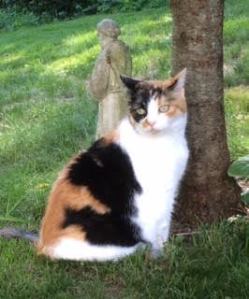
 The reputation of calico’s was revealed during a vet visit. “Oh no,” the animal tech whispered as she put the thick gloves on, “one of those.” Until then, I wondered why this young cat seemed so sassy. So, her grumpiness was a trait and something to be wary of. Sweetie Pi had an independently confirmed case of “cat-titude”.
This calico cat came into my life sometime in the spring of 2007. Her coat of white, black and burnt sienna caught the eye in daylight or night. The nickname, “Clementine” came to mind one day as I watched her meander around the laundry room door. Why is she a wanderer, I wondered? Who is her owner?
At that time, I had a house cat named Gigi, a ten-year-old tortoiseshell brought home in 2005 from a local shelter. She’d lost her longtime owner to cancer and been at the shelter for six months. The attendant had to reach under the bed to retrieve her the day I stopped in to just take a look at this kitty. As I held her, she promptly took a bite on my hand. Still, she had something and I was persuaded to take her home that same day. Over the next two years, we’d developed a strong bond of friendship. Ever the believer in letting an animal follow it’s instincts. I encouraged her to roam out onto our 2nd floor balcony to enjoy the outdoors. The scene below revealed a small woodland with water trickling over stones. So many birds lived in the copse, visiting our feeder routinely for seeds and nuts. One evening, I startled a flying squirrel into stillness as he was hanging on the feeder munching on peanuts. Gigi eventually became quite comfortable roaming down the stairs and exploring the quiet woods. Many pleasant moments passed with her sipping stream water and watching skeeter bugs.
Into this idyll, a young calico appeared routinely wandering around. It was puzzling to figure out who the owner was. Given the woodland setting and routine howling from coyotes in the night, it was not wise to leave a house cat out all day and night. The day I saw her leap and catch a bird in flight, I decided she needed a roof over her head. I started to provide food and attention, inviting her to come inside. That spring had been damp with too much rain. Before another soaker could begin, I remember inviting her in and didn’t she curl up in a basket that was much too small for her and doze off for hours.
Gigi tolerated Sweetie. She didn’t feel at all sympathetic to a vagabond cat. But, given by now it was late summer, Sweetie had to move indoors somewhere, else she’d grow wild or worse, lose her life to a predator. I had sorted out who the owner was and asked them if I could take her in. Apparently, she was adopted from a local shelter for the amusement of the man’s son when he had visitation rights. Which meant she was fed and noticed about every other week, otherwise, she was booted outside. When a moving van arrived one day, the owner reluctantly let me take her. He was relocating to the city of Springfield and did seem to genuinely want her to join them. But, Sweetie made her own choice when she ran out the door and couldn’t be found.
Glad to have her, she moved in without doubt. A visit to the vet gave her age to be about 1 ½ years old. An animal communicator relayed a memory of being taken by a man to a shelter. He left her there and she was still waiting for him to return. She’d had about five homes by the time I arrived on the scene. She was permitted to roam outside, but when the sun set and supper was served, indoors she must stay.
I remember how she took to sleeping on a futon chair and hissed at me when I would approach her. Ticks seemed to love her and were often embedded in her face and neck. To keep her still, I had to sort of kneel over her and trap here between my legs to twist the bugs out. Somehow she earned the nickname Peanut. Why? I don’t recall. It wasn’t until the veterinary visit when the techs whispered about the calico attitude that I realized she was a bit anxious without reason. I thought it might be her transient early life. She easily showed whatever emotional state she was in and hissy and pissy was one of them. Gigi, being a tortoiseshell, is a calico, however, she displayed a cool standoffishness most of the time. Apparently, her expression was considered a bit mean by some folks. The attitude was more aloof. Gigi meowed and cooed a bit. Sweetie yelled and screamed a lot. Sometimes neighbors could be heard to tsk at the sound of her meow.
We got along. Gigi would rarely sleep on the bed with me. Sweetie perfected the art of lying on my hip all night long. If I turned over slowly, she would adjust her place and resettle in.
It was when I bought my house that life improved for us all. No more noisy neighbors. But, the move coincided with my mother’s health deteriorating to the point she could no longer keep her housecat. Suddenly, I inherited a large gray male tabby cat who needed quite a lot of attention. We managed, I remember moving day required three cat carriers. I left them in the basement in the carriers while the furniture was moved in. Once all was settled, they were allowed out to start roaming around.
Sweetie enjoyed the garden. All the cats learned to use the pet door in the walk out basement. They had a big yard to explore, and trees to sharpen their claws on. We got along and enjoyed our little home. Eventually, Poncho died and a few years later, I lost Gigi at 19 years old. Sweetie had what she really wanted, Mom and the house to herself. I remember thinking we could grow old together, she was about nine and would be my last house cat. We had a few years together. It was early January 2017 when I came home to find she had died. She was lying quietly on her favorite chair but did not react when I came in. Something felt wrong. I thought I felt a heartbeat. But, she was big and limp. I did take her to the vet’s and had to take in the awful news. How could she be gone? The vet said it could have been an aneurism or heart attack. She was gone.
Soon will be the fourth anniversary of her crossing the rainbow bridge. What an impression she has left. How much she is still missed today. Since then, two different house cats have come along and we live happily together. Sweetie would have hated them and put up such a snit. I remember feeding a stray cat on the doorsteps and seeing her make such an ugly face. How is it a cat with such a beautiful coat could be almost hysterical at times over the smallest discomfort?
SO, be warned, if you’ve taken in a calico kitten or cat, it’s not you. They are born with cattitude and are super proud of it!
RIP Sweetie Pi
 It’s actually appealing in that material that is normally put in the waste stream is salvaged to create miniature greenhouses that allow the seed to experience freeze/thaw, but provide for germination in a controlled environment. So much of seeding and germinating is happenstance. When the conditions are right, the seeds will sprout. This winter sowing helps to provide this condition.
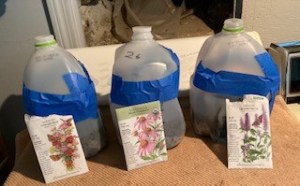 Apparently, there are also optimum days to seed and a reference to this helped establish those days. December 20 was mentioned to be one best day to plant among many so called ember days.
 In the pots are Penstemon, cornflower and hyssop.
 LuceStellare