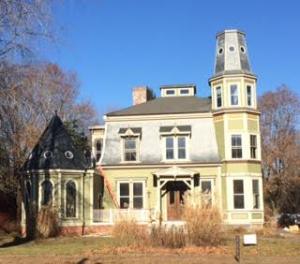
 Along the Quaboag River, on the western edge of Worcester County, travelers on Route 9 pass by Howard’s Drive-In, Honey Bee Orchards, down the hill and over Coy’s Brook into the Historic Center District of West Brookfield Massachusetts. The five acre tear drop shaped common fans out to a panoramic view of 204 houses, barns, outbuildings, stores, a Town Hall, Public Library, tavern, seminary and three churches. The common is one of the best preserved in Worcester County. A baseball diamond at the east end has felt the slide of generations of sneakers. The Rice Memorial Fountain water nymphs refresh weary walkers with their gentle spray. Every July 4th, an evening bonfire is lit in celebration of life in a small New England town. Over by the Congregational Church with its classic meetinghouse spire, is a three-storied stick style towered Victorian known as Windemere House. On the west side of Main Street stands another Victorian. Forsaken five years ago, it stood cold and estranged with no light shining from within. Now, the wheel of fortune has spun and the grand house is coming back to life. There is activity in the courtyard. Commuters slow down to check on the daily progress. Neighbors pause to reminisce on what it was and what it might be. West Brookfield welcomes the return of the Envy House. Chuck Atkins and Gregory Morse of Worcester are the new owners of Fales Mansion.
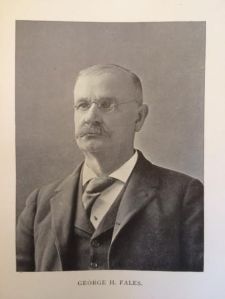
George H. Fales (1834-1903) built his Victorian in 1873. It was designed by architect W.G. Preston of Boston. Preston had commissions in Massachusetts, New York, Rhode Island and Georgia. His collected works include 10,000 municipal building and private home designs. Preston’s constructions include MIT’s Rogers Building, John Hancock Building on Devonshire Street Boston and Jacob Sleeper Hall at Boston University. Fales inherited a profitable shoe manufacturing business and was active in town governance. He had a flair for business and owned a large amount of property in town. He loved music and played the organ for the Congregational Church for 50 years. His daughter Charlotte (1871-1971), “Lottie,” continued for 50 more. Fales married Laurinda Tomblen in 1864. Her brother John built Windemere in 1880 with the intent to rival the grandeur of Fales hence the name Envy. The competition was between the sisters-in-law to own the most stylish residence in town. Both houses are designed to be big and bold. They are private homes that fill the eye by their sheer size, both being over 4,000 square feet, two stories with a dramatic corner tower adding an additional story. Windemere is in good condition and now a doctor’s office.
 The Fales Mansion was sold out of the family 40 years ago. His son John died after one year of life. The eldest daughter Mary Ilione, married Samuel Wass, their son George inherited the estate after Lottie died. Trudy died at four. Lottie never married. Marguerite had a childless marriage. Of Georgie Belle, little could be found about her life although she lived to the age of 85 dying in 1962. In the 1980s, it became The Brookfield House restaurant. It has been the scene of a contentious divorce or two and almost lost in a fire. How could any house reach the great age of 142 without a few skeletons in the closet.
Old houses “are important members of the community and embody the physical history of the town” said Susan Ceccaci of Preservation Worcester. “They are a landmark and part of the townscape, if torn down, would interrupt the streetscape and leave a large hole in the environment. It’s far easier to remember and understand history when something is physically still there.” The challenge for residents will be the concept of the house as part of the town’s history but a private home. A previous owner commented that every two weeks, a stranger would knock on the door and ask to see inside. The house has been unoccupied for five years. People have been pilfering perennial plantings from the front yard. Folks walk around the property taking pictures as if it were a public space. There is a fine line between curious and intrusive. The house was built to be seen and enjoyed for its magnificence. When an old house acquires a new owner, the collective historic significance and character come along as well.
Edward Gordon, President of the New England Chapter of the Victorian Society, described the Fales house as “a stylistically eclectic example of a mid-nineteenth century country mansion. Victorian is an umbrella term that over arches the many architectural styles that fall within the period of 1837-1901–the years of Queen Victoria’s reign–with that said the primary style is Mansard as seen in the roof configuration–in this case it is a hip-on-mansard roof. The Mansard Style has its roots in French architecture going back to the late 17th century and then revisited in Napoleon III’s France during the 1850s and 1860s. The Mansard’s double pitched roof was part attic and full top floor and was where servants, storage and even billiard rooms were placed (in the last case in American city houses)
The corner tower component at right has a roof with circular or occulus windows which are frequently used in conjunction with mansard roofs. There is also evidence of the Italianate style as seen in the arched first floor windows of the conical-roofed structural component at left as well as the bracketed and cornice-headed lintels of some of the first floor windows. The Italianate Style was popular in the US from around 1850 until the 1870s and persisted as a “go-to” style in certain neighborhoods and towns until as late as the mid 1880s. The house is also Stick Style referenced in the porch roof and dormer windows–more specifically the angled bracing that extends from the porch posts to the roof as well as the saw-cut kingpost which is evident within the triangular configuration that is at the center, above the porch entrance as well as at the center of the dormers.”
Each window facing the street has a dormer with spire and extensive stick work. The corner dormer frames have fan shaped braces and stenciled design. There are five steps up to the double entry golden oak front doors and stick style porch with eleven stars stenciled into the overhang on the front and six on each side. The left parlor although appearing to be square on the outside, is actually a perfect pentagon of five walls. At the top of each wall is a cornice creating a shadow effect around the room. On the ceiling is a perfect band of crown molding in the same pentagon matching the wall cornices. The fireplace surround is intact. The main staircase is a solid straight rise, but the back staircase on the west side of the house is the showstopper with an S-curve oak banister. The arced tread and risers are built into the back wall and follow that exquisite S all the way to the top. It resembles a staircase inside a lighthouse. The quality is stunning. “The wood work displays craftsmanship and preserves the hand of man in design,”said Ceccaci. The morning room windows are six feet tall. The ceilings in the main house rise 12 and 15 feet in the kitchen. There are six bedrooms, a music and flower room. The corner tower is also a pentagon and built southeast to catch the rising sun.
Preservation of houses tends to be up to the individual owners. Gordon said, “New England is big on preserving its Colonial and Federal architectural legacy. Victorian design has always taken a back seat in this region despite the fact that so many cities and towns have spectacular examples from that period.” The National Historic Preservation Act was enacted only fifty years ago. The National Register of Historic Places may preserve the space, but funding is likely to be out-of-pocket for restoration. Historic Preservation consultant, Jen Doherty said it is cheaper to build new as what may look remarkable on the outside, can have invisible things that stop progress.
The house served as the residence of “The Mystic Phyles” character Abigail Thaddeus in 2011. Stephanie Brockway and Ralph Masiello, author and illustrator lived there from 2003 to 2010. Masiello said the house has “great bones.” The frame is made of solid chestnut. The interior woodwork is black walnut and oak. The pocket doors slide effortlessly. There is no warp or sag to the structure. The doorknobs are made of mercury glass. Previous owners pilfered the mansion selling chandeliers, fireplace mantels, antique baby carriages and furniture to pay the mortgage. Masiello wanted to add the house to the National Register of Historic places. But, they lost it to the Great Recession of 2008. Masiello hosted Halloween open house and skating parties in the courtyard. He meant the house to be open and a public place to be celebrated.
The new owners will be an object of curiosity because of the houses value as a historic member of the West Brookfield community. The grapevine has a figure of $300,000 to $500,000 for renovations. The mild November weather has permitted an exterior painting of four, not five colors. The body of the house is sage green, the trim are oyster white, soft fawn and nutmeg brown. The dove grey slate is going up on the roof. Will the tower once again wear a golden coronet? The best reason for conservation of old houses may be the sentimental value alone. Ceccaci said, “They serve the role of connecting generations of inhabitants.” The oral history is shared with those eager to soak it in.
Conservation and preservation are not a new concern to the history of the town. An article from the Spencer Sun, May 25, 1877 talks about progress coming to West Brookfield in the addition of concrete sidewalks and the loss of a pine tree near the Fales House. “The old pine tree, about the largest in town, near the residence of George Fales, Esq, has gone, root and branch. It was almost 175 years of age….Many an old landmark has been removed in our village within a few weeks.” It took five horses to pull up the roots of the old tree. Something important was lost that day. “Woodman, spare that tree. But does it not show a spirit of vandalism that the act has been committed and that many a noble and aged tree has been cut down.” The loss of trees lamented so long ago. The pine would have been planted around early 1700, it may have seen the passage of the Nipmuc on the way to the winter camp at the area now known as Rock House Reservation. The early settlers establishing Ye Olde Tavern as a way station between Springfield and Marlboro. George Washington make his ceremonial pass through the area in 1789.
Local historian, William Jankins, cut the grass at the Fales Mansion as a young boy and recalls Lottie and her sister Marguerite as demanding old ladies. Lottie died in 1971, just shy of her 100th birthday. He remembered a formal Victorian garden. There was a porch on the east side of the house with a large exterior box off the kitchen with a locked outer door. The key was in the pocket of the local ice vendor. He never went in the house. Fales had shares in a private aquifer system that piped fresh water into the house from Long Hill Road. Jankins was born in a part of Greenwich and West Hardwick lost to the Quabbin Reservoir, the municipal water supply for the city of Boston, 76 years ago. John Tomblen’s wife, Mary Frances Shaw, was born in the submerged town of Prescott. He is a living link to places and people fading out of the collective memory.
An October posting with photo from the 1980s on the West Brookfield Facebook public group page keeps rising up to the top with 149 likes and 74 comments including several from the new owner Chuck Atkins. The comments are fragments of history. Atkins said it would be a private home and hopefully ready in time for next year’s Halloween. His partner, Gregory Morse, mentioned being contacted by the Quaboag Historical Society. The support of the community is for the preservation and celebration of what makes this town so historic. The most common request is what will the restoration be like? Atkins said, “I’ve been in love with the house since the fire, about 16 years ago. I’m thrilled to be able to restore it. It will be done right.”
@FrancesAnnWychorski2015
Acknowledgements

Heartfelt thanks to all those who helped in the writing of this story. The afternoon in the Jankins parlor was simply mesmerizing. His collection on the town was endless with maps, documents, postcards and photographs. When I walked out of his colonial farmhouse, I swam a little in confusion of what year it was. There was the common The meetinghouse spire against a cold grey November sky. Windemere House was sitting pretty on the corner.
Unfortunately, I could not find a photo of the Fales, only their final resting place in Pine Grove Cemetery. For all the opulence of the mansion, here was a relatively unadorned tombstone. Rest in peace George, Laurinda, Mary, John, Gertrude, Marguerite, Charlotte and Georgie Belle.
Sources
Victorian Society of America
New England Chapter
Edward Gordon, President, VSA/NE
The Gibson House Museum
137 Beacon Street
Boston MA
Preservation Worcester– Susan Ceccaci
10 Cedar Street
Worcester, MA
Jennifer Doherty
Historic Preservation Consultant
William Jankins, Local Historian, West Brookfield MA
Brenda Metterville, Library Director, Brookfield MA
Barbara Rossman, West Brookfield Historical Commission
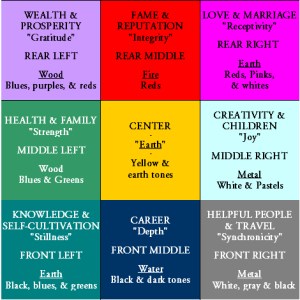
 One question came to mind in the process of activating the right hand corner. Is it just the front entrance, or is it every right hand corner through a doorway in the house? This proved easier to adjust and several changes were made. At the right turn entering the kitchen, I put two silver crickets on the windowsill. The plan suggested silver and metal to activate the energy. The crickets are from the Lucky Nail Blacksmith Shop in Sturbridge, Massachusetts. A card that came with purchase explains, “Middle Eastern and European craftsman commonly carved amulets and charms bearing images of crickets to fend off evil spirits. Crickets have played strong roles throughout Chinese, Japanese and Native American cultures as a symbol of good fortune, vitality and prosperity.”
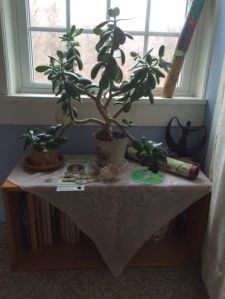 An “altar” is on display in an upper room in the right hand corner. I made a jade plant the centerpiece as they are associated with good feng shui. The leaves are round and that is pleasing to benevolent chi. The bookshelf contains travel books, maps, and language guides for Italy, France, and Ireland. There is a coastal map of Agrigento province Sicily. A brochure for a Mozart tour in Munich, Salzburg, Vienna, and Prague. A CD for drive time practice of Italian. Euros in coin brought back from a trip to Sicily early this year. There is also a rain stick on the windowsill from Albuquerque New Mexico. It is filled with dried peas that rattle over spokes inside making a delightful sound of gentle rain when shaken. The suggestions included displaying water. Rain sticks are shaken to ask the spirit of the clouds to share some water with the earth. This object may come out, but it does represent a travel destination once enjoyed. I’d love to go back to Santa Fe next time. I definitely want to travel again soon and hope these things will manifest somehow, someway.
 Prosperity
 LuceStellare