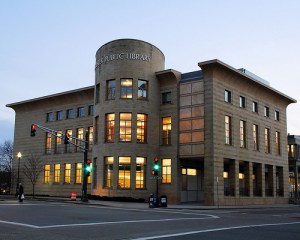
 Worcester, in the heart of the commonwealth, is Massachusetts’ second largest city. Worcester Public Library (WPL) at Salem Square in the downtown district provides services for 181,000 residents. Immigrants may take English language and citizenship classes. Entrepreneurs participate in small business workshops. There are book clubs for different generations of readers. History buffs and genealogists have access to maps, databases and records for Worcester County. The motto of the library is: Your Open Door to Opportunity. The privacy rights of all patrons are an integral part of daily service. When WPL automated materials check in and check out, it gained efficiencies and a deeper layer of security for patrons.
The decision to automate services at WPL is the result of collaboration between former Worcester City Manager Michael O’Brien, city councilors and former Library Director Wei Jeng-Chu. The automated materials handling service (AMH) was installed in April 2013. The Lyngsoe System AMH costs $320,000 and includes radio tags on materials. Danielle Mattei, circulation manager, said the former director called it “the Willy Wonka Machine.” Patrons return materials at the outdoor or indoor kiosk. The interactive keypad offers direction in English, Spanish, Vietnamese and Chinese. A scanner reads a barcode on materials placed in the drop off box and whisks it down a conveyor belt to the appropriate bin.
Head Librarian Geoffrey Dickinson is pleased with the speed of getting materials back out for loan. “WPL has an annual circulation in excess of 900,000 items per year,” said former Circulation Services Manager Anne White. “A returned item passed through many hands and several days before getting back on the shelves. Now everything is completed in less than a day…in August the average turnaround time was down to five hours.”
The check out provided by Bibliotheca Library Systems cost $135,470. Patrons activate the service with a library card and pin number. A scanner reads the barcode. A receipt shows only the name of the items loaned with a return date. There is no name or card number assigned. When the materials are returned, the information is deleted from the records. Any fines are noted on the receipt. The patron may also check material out at the staffed service desk near the kiosk. A librarian at WPL said patrons may want to refer to something previously loaned, but the information cannot be retrieved.
This feature of the drop off and check out systems protects the privacy of patrons. Both the Council of American Library and Association of Librarians strongly recommend “the names of library users to be confidential.” Why? “Intellectual freedom and the right to research can be preserved only if patron privacy is respected,” as stated in the Slate article, June 2015, by April Glaser, “Long Before Snowden, Librarians Were Anti-Surveillance Heroes.” The Patriot Act, passed in October 2001, gave the National Security Administration access to library records under Section 215. This provision expired in June 2015. While active, librarians could be subject to subpoena from FBI for patron records. Librarians were prohibited from telling patrons about the records request. Therefore, the actual number of requests is unknown. In 2005, a library in Bridgeport Connecticut received a national security letter from the FBI for patron data. The library staff “filed a brief in the Supreme Court to challenge the Patriot Act,” said Glaser. In September 2007, U.S. District Judge Victor Marrero heard the case and found the entire national security letter provision of the Patriot Act was unconstitutional. “In October 2001, a University of Illinois survey found that 85 libraries had been contacted with government requests.” The American Library Association released a survey in June 2015 showing that law enforcement officials had contacted libraries at least 200 times since 2001 with formal and informal inquiries about their internal records, Eric Lichtblau wrote in The New York Times.
WPL Privacy Policy “champions the protection of personal privacy.” If a subpoena or letter is served on the library, hoops have to be navigated before data is released. The librarian contacts the City of Worcester Law Department to determine if procedure has been followed. If confirmed, the Board of Directors are notified before the library will comply with the request. This also applies to public searches for information in the library online search catalog and public computers. Within 48 hours, the automated systems wipe the records clean of activity. The FBI and other authorities may want to know what patrons are accessing but at WPL it is almost impossible.
 The installation of the automated system did not cause any job loss, Mattei said. In fact, because of the efficiency, Bookmobile city service has expanded. Two libraries on wheels, Libby and Lilly, provide monthly services to retirement homes, community centers and several private and public schools without libraries or librarians on staff. Efficiency in automation also allows the Library to fulfill its goal of maintaining five branches in Worcester. “The WPL is a community center not just for books but technology providing 24 hour service on-line. Technology enhances service, it does not replace it,” said Mattei.

 Baskets have been part of households for thousands of years. When they came into use is difficult to know. Pottery, intact or in shards, can be dated by archeologists. Baskets, made of natural fibers, decayed long ago. A basket is made by intertwining material in a specific pattern. A deceptively simple design that holds itself together by the weave. The idea may have come from birds. The nest is a circle of grasses and mud woven together by a beak with instincts as a guide. The placement is so wise, it takes the strongest winds to knock them out of trees. Nests seem delicate yet are strong, as are baskets. There are many styles, techniques and materials for weaving. The uses are limitless from holding eggs to people in a hot air balloon as it floats up into the sky. Basket makers, also called weavers, carry forward a handcraft that connects us through the centuries from our humblest beginnings into modern times. The craft is alive and well in safe hands.
 Claire Williams, a costumed staff member at Old Sturbridge Village Living History Museum (OSV), learned the craft from a friend 35 years ago. OSV is a complete preserved working town from farm field to Parsons House in Sturbridge, Massachusetts. The village depicts life as it was in the 1830s. Williams “always has one going.” The basket is an intricate puzzle made from oak and ash tree splints, cattail leaves, reeds, or grasses. This material is known as the weaver. The dimensions and design are measured before a basket is started. The base is the most complex part as it must join the spokes around which the weaver is laced. The spokes are the skeleton of the basket. The handle is made from different woods and carved or steamed into its shape. The handle slides into the weaver and is notched into the rim. The rim is lashed on with twine. The finished piece has a stable base, is sturdy, balanced, lightweight and can last for years. Where the weave starts and new material is added as it is being constructed is hard to distinguish. It appears as one seamless piece. Depending on the complexity of the design, it may take from two to ten hours to complete.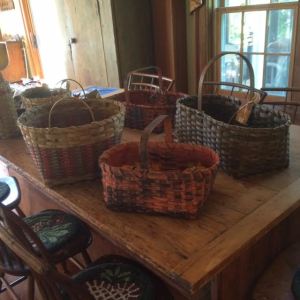
 LuceStellare