On the tenth day of my adventure, I am in San Leone at a seaside cottage in Agrigento Province. On this morning, I saw the natural wonder of La Scala dei Turchi in nearby Realmonte. I spent some time in the presence of this great beauty. Now I understand how myths are formed. I wouldn’t be surprised to find that on moonlit evenings, sea nymphs lounge on the steps. After a lunch break and a little rest, I headed into Campobello di Licata to meet a friend I had made via social media. I was excited and expectant as to what this meeting could bring. We’d not met in person and I took it on a leap of faith that this could be fun.
This small town is tucked away in Agrigento Province about one hour’s drive from Licata which is near the sea. The roads are graceful, winding around cultivated fields of grain, olive and citrus trees, grapevines, and vegetables. The island so far, doesn’t have large stands of forests. I have yet to see an evergreen tree. The day was light and airy with fresh breezes ruffling the meadows. Campobello in English means beautiful field.
The day before this visit, I had been in Naro, a neighboring town steeped in medieval and baroque architecture. Naro felt ancient compared to Campobello. The streets are wider. The buildings are constructed of honey colored local stone with a fine stucco of light butter cream. Relatively speaking, the town actually is newer than Naro. Campobello relocated from the original settlement, as the water source was low lying and a breeding ground for malaria. Before one stone moved, a steady spring of clean water was found. The well in this picture was built in 1056 and was the original water source for the old town. This had been the center of activity for centuries and the place women walked to daily for water. Now, it is quiet, if only this well could talk, the stories it could share.
The commune’s formal name is Campobello di Licata Citta d’ Arte or the City of Arts. I was soon to find out why. My social media friend, Giovanni is a physiotherapist with a private practice on Van Gogh Street. Right away, I felt at ease in his company. He has a quiet way of moving about and took pride in showing me his business and accomplishments. He is intelligent, soft-spoken and generous. I got the impression this guy has a funny bone that given more time, I would have come to know.
After we exchanged greetings, and gifts, he quickly introduced me to another artist of prominence associated with the town named Silvio Benedetto. We spent quite some time in exploring this man’s art. Giovanni was kind enough to arrange a tour. His daughter Francesca, Piera and Uncle Giuseppe Rotolo, joined us. Signor Rotolo had lived in the United States and spoke English. My Italian was weak but growing stronger each day. Between the two of us, we managed to exchange quite a bit of history about the town.
One of the reasons I liked this town so much is that the main square is wide open and flat. The walk into the Chiesa Madre San Giovanni Battista or St. John the Baptist, was only a few steps and not a dramatic 50 or 100+ easily encountered in Sicily. The church had been built by the Baron of Campobello di Licata, Raimondo Raimondetta who bought the village in 1681. The family emblem of the rose was visible inside the knave and outside on the sidewalks around the square.
We toured Piazza Aldo Moro with its lively, large fountain splashing around sculptures of children and stones. We went into La Fenice café for gelato. My favorite flavor is nocciola; hazelnut ice cream blended with nutella. Gelato has a creamy, smooth texture on the tongue. The basic recipe includes eggs, heavy cream and whole milk. It’s not too sugary, just naturally lovely and satisfying. While we were being served, I noticed everyone sitting down in the café were men. This was around 3 o’clock in the afternoon. There were photographs of Marilyn Monroe and Audrey Hepburn on the walls. I asked Piera where all the women were? At home she said. This is a pattern I noticed in every Sicilian town. The men congregated and chatted at cafes, barber shops, and the bar. I must have given them something to talk about for days. I don’t think many Americans visit Campobello di Licata.
The main corso was unusual in it had trees growing along the walkways for shade and beauty. Apart from flower pots and balcony gardens, trees on the main boulevard in most cities were uncommon. There were kids drawing with chalk in the city square preparing for an art exhibit. The town municipal buildings are painted with several murals by Silvio Benedetto. He is a popular artist in Italy known for painting grand murals on public buildings in several Italian towns. Benedetto (which means the blessed) is a sculptor, illustrator, photographer, poet, dreamer, and visionary. He also has a keen eye for town planning. He came to Campobello di Licata during the 1980s and assisted with the major restoration of the downtown area. He brought a conceptual design to the squares, monuments and sculptures. The area surrounding the Chiesa Madre or Mother Church flows from one outdoor space to another. Benedetto likes curves and I tended to experience everything in a round shape. His art was so important, that he was given the entire municipal building as a canvas to paint on. Here is a photograph of his work. Clearly, the town embraced his vision and art for generations to come.
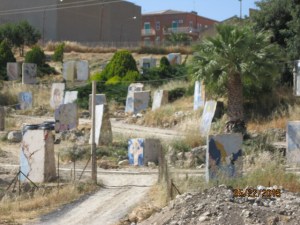
I was taken to view the Parco della Divina Comedia currently under construction. There are 102 stones all with characters and scenes from The Divine Comedy by Dante Alighieri. The exhibit had been on display in Rome and was now being permanently placed right in Campobello di Licata. Dante is so well admired beyond Italy, that I can well imagine this becoming a destination for both fans of Benedetto and Dante. Giovanni talked about a museum for Silvio Benedetto at, Le Gole Alcantara Parco Botanico e Geologico near Taormina in the Province of Siracusa.
On a practical note, the Sicilian need for locked doors took on a deeper dimension in Naro and Campobello. When I visited with Giuseppe and Giovanni both were at work with the shops open for business. An optometry shop and physiotherapist. However, the front door at both places is locked during business hours. People arriving for appointments are buzzed in. Curious! There wasn’t a lot of foot traffic in either town. They are not tourist destinations. Naro’s streets are so narrow that only tiny Fiat’s could make it around certain parts of the city. The town hall was open when I met Piero’s mom. Churches are open. But, a business is locked?
All in all, I had a wonderful visit to Campobello di Licata, and like everywhere I had been in Sicily, there was more to see and appreciate. I promise myself to return with better language skills and to devote more energy to exploring these quiet corners of Sicily. I wanted most to stay in Agrigento Province with its rolling hillsides, cool evening breezes, and soft sunshine. I am grateful to the Nigro and Rotolo family for taking the time to fill me with precious memories of a wonderful day.
My journey through paradise brings me to, Costa della Provincia di Agrigento, the coast at Agrigento Province. The Greeks called this area Akragas. Unusual for Sicily, most of the houses around here are private homes with gated entries. The narrow winding lanes are just wide enough for one car. My new “home” is behind a tall white paneled gate cascading with jasmine flowers. I arrive in the afternoon, meeting the homeowner at their seaside restaurant in town, from there, it’s a short drive to their property. I am in San Leone, Lido di Agrigento (beachside) in a cottage, and a half hour walk to the Mediterranean Sea.
A big woofy brown dog with a curly coat welcomes me into the courtyard. The homeowner greets me and shows me to the cottage, separate from the main house by a few steps. Rosa is in her mid-thirties, willowy and beautiful with two teenage children, Ricco and Maria, at home. It’s a two-story chalet made of wood and feels new. The first floor opens into one spacious room with the dining area, a kitchen and a small bath. A staircase leads up to the one bedroom with a private porch and view over the rooftops and out to the sea. The layout is spacious and homey. As before, there is a sharing of keys and directions on opening and closing the gate. The daughter shows me how to light the gas stove and I refresh with a cup of black tea. Tomorrow includes a visit to Scala dei Turchi, in English, Turkish Steps and the town of Campobello di Licata in the afternoon.
The sun rises on a brisk day with an onshore breeze cooling this side of the island. The terrain is gentler here with rolling hills of grapevines and fields of wheat. Plant life must be adaptable to strong shifts in climate. Most days are sunny. The sun angle is different, it is overhead most of the time. Back in New England, it normally angles south, southeast. It is so nice to be always walking in sunshine. The nights are cool and misty. Plant roots must go deep to find fresh water and anchor well into the soil. It’s a loose sandy, loam colored in tones of buckwheat and buckskin. Branches must sway and give in to the elements or be cracked to bits. The flowers, so delicate and sweet must tremble with the wind or be dashed by it. The people of Sicily must also be so strong to the roots, and flexible to what can happen in life.
In the coastal town of Realemonte near Porto Empedocles is Scala dei Turchi, an enormous white cliff poised at the sea’s edge. The site is not a park or reserve. There are no entry fees or services. There is hardly a sign to tell visitors where to go nor is it visible from the road. The parking lot, like most in Sicily, is an afterthought. In fact, people have to walk through a seaside bar to reach the path to the cliffs. Visitors are responsible for their own safety.
The walk is about fifteen minutes along the shoreline. The sea is on the left and a tumble down hillside angles up to the right. The slope increases, as I get closer to the cliff. Strange, the thing missing at all these seaside places is shore birds. Gulls are so common a sound and sight back home that it always feels like something is missing here. The aroma of sea air is also milder. The Atlantic Ocean makes itself known with a strong scent of seaweed, surf and sun when approached. The Mediterranean is more subtle, content to dazzle the eye at first.
My steps slowed along the way, another bit of wonder showed itself. I heard it before I saw it. A little fresh water rivulet was seeping out from the hillside. A small stream continued towards the sea. It was trickling through the soil and forming tiny stalactites. It made it! “All the waters run to the sea and yet the sea is not full, and from the place where they began, thither they return again” Ecclesiastes. Something so small compared to something so large. How did I see that?
On the shoreline, the sea spills over rocky square formations just under the surface, rising and sinking with the current. The formations make for great walkways out into the sea. Perhaps they are carved from something more ancient. They appear man made but terribly worn down and covered in barnacles. What did these hold up? Was this the port? The next land mass from here would be the north coast of Africa. All that remains is washed out stepping-stones to no man made structure. So much has been swept away.
The sea fills the horizon and laps over the foot of the cliff. Tender waves turn the mottled white surface pigeon grey. This cliff face is made of marlstone, a lime-rich clay. When it’s wet, the stone is sleek and looks like the skin of a whale as it rises to the surface to draw breath. There is sensuality in the movement of water touching the rock. If the cliff could talk, she would say, The sea, the sea, she caresses me. Rolls over my footstones, how she always reaches to me. What is the name of this sacred place? The tranquility of this day, this touches a place inside, and creates a sensation of emptiness, of being released from the confinement of form. This journey around Sicily has become an unplanned pilgrimage to nature surrounding ancient shrines. Yes, equally in recognition of the named for goddess, but also what memory is left behind in the earth and stone. These places reflect an energy from long ago and I feel it.
This massive stone is here. Is this what the moon looks like? Does the stone reach out to the sea or the sea reach out to the stone? They could not be more different. One is the rock. One is the water. The wind gently, gently carves away at the surface. The sea spray polishes it smooth. The sun blesses its existence. In the darkness, the moon, should she look below, sees something of herself on the earth’s surface.
Stepping onto the cliff face is easy. It seems made for humans or animals to climb. The surface looks like chalk and may be soft. Underfoot, it feels slightly tacky. Up close, it is more solid, but not strong like marble. Marlstone is lime rich mud, mudstone? It’s clay and silt. This substance, found in riverbeds, is an old familiar friend. This is the sort of mush frogs and small freshwater creatures love to be in. Mix in some sand, ash, crushed shell and this forms the basic plaster used in homes on the floors and walls for thousands of years. This is so familiar. Some part of me remembers walking on this before. Somehow, nature crystallizes the calcite in the minerals and creates this substance.
The slight incline is easy to walk up at first and pitched at a slight angle. The slope draws the feet upward inclining a bit more and more as it rises about one-story high. The sound of the sea lapping stays quietly with me. The wind is mild today and blowing inland. The walk goes onward and the cliff face rises some more. It flattens out into grooves wide enough for one and ½ people to walk along. It’s kind of like Italian roads, not quite enough room to maneuver. There are layers to the grooves going upwards so if someone comes the other way, you can step up into another groove and carry on. Sort of like furrows along the cliff walk. She knows. The goddess of this marlstone knows how to make it inviting to explore her. The ancient Egyptian’s had a story about Khnum, the creator god of the Nile River. He crafted human children from this substance on a potter’s wheel and placed them in a mother’s womb.
Who is she? Aeolus is present in the wind. Helios lights the eyes. Keep going and the cliff face gets longer, wider and taller. Rounding a bend, it keeps going for about two miles. The grooves are now getting steeper to walk on. I wish I had my walking stick. A brave soul with cleats on the shoe could keep going all the way around. The cliff rises up and up, down and down to the sea. I can see coves below. Secret places the sea can enter into the land. I decided to stop and sit on the stone. This looks much like a natural amphitheater. The way it pitches up gradually and is comfortable. The theater is the sea and sky. There are enough seats for thousands of spectators. So, it is time to gaze at the sea.
Today, she is every shade of green, blue and silver. Over there, she is bottle green, emerald, sage, aquamarine, teal and dove green. Here, she is china blue, silver blue, cobalt and azure. No boats are on the water. The waves roll in without effort. They roll to her. The sea rolls to the land and will not stop. The wind will not stop. Imagine what it must be like when it is fierce. I would not feel so welcomed. I can see why it is called scala (stair). They are steps. Mary Taylor Semiti, author of “On Persephone’s Island” said about the site, “Scala dei Turchi, apparently owe their name to the fact that, they offered good anchorage for Barbary Coast pirates (not to Turks at all but North Africans) that repeatedly raided Sicily in search of plunder and captives to sell as slaves.” Why is Sicily so easy to conquer by outsiders? Why does she let them all in?
Standing on the shore, the rhythm of the sea and wind takes over and sweeps away any deliberation in thought. There is wonder in gazing from the cliffs to the gorgeous palette of the sea. I see large dark swirls in the water, as there are no clouds in the sky today, it might be fish just under the surface, forming and dispersing quickly in the placid waters. There’s only earth, sea, sun and sky. The steps are here for some nautical god to rise onto the land. Who would come out of the sea to meet Sicilia? Who would be worthy of her?
It is hard to leave here. How fine it is to feel overcome by the senses and know for a while that nothing else matters. This is the land of Demeter and Persephone, Artemis and Arethusa. I met Arethusa in Ortygia and found her journey led here in this little fresh water stream coming down the hillside. Her fate took her underground to dwell in safe passages. Here she is, she made it to the seashore at last.
Visit on a clear day and marvel at the wonder of it all. Feel the sun, wind, and water and know something beautiful that only nature could create. Let the sea fill the senses. Leave all thoughts behind and be a part of it all. Take your time and stay on the cliff as long as it feels right to. The warmth of the sun and rock face are forever. There is no time, no place and nothing that matters anymore. Just sit; there is nothing else to do. Sicily is everything I wish I could be.
Naro may not be the most well-known stop on the tourist trail through Sicily. The ancient city is settled on the crest of a hill in the province of Agrigento overlooking La Valle del Paradiso, Paradise Valley about an hour’s drive from the coast. Many Sicilian cities are situated in this manner partly because of the topography. This is also a defensive position allowing the guards to sound an alarm should invaders be on the march. Sicily has a right to be wary of foreigners. All the powers of the Mediterranean and even the Minoans have put their boot on Sicily. Why? The island is a paradise. The land is fertile. The hillsides throughout Sicily are cultivated with grape vines, olive, citrus and fruit trees, grain and vegetables. The crops are planted in neat rows encased by tidy stone walls or shrubs defining each plot of land. Wild flowers of poppy and broom are abundant and cling to the edges of the fields. The climate offers two excellent growing seasons. The wind is constant allowing for pollination and air circulation around crops. The rains are plentiful in their season and the sun is strong.
Naro was not directly affected by the earthquake in 1693 that shattered the southeastern side of the island. The damage was so severe that several cities in the Province of Siracusa actually moved rather than rebuild. The quake knocked over walls in Agrigento and was even felt in Palermo. The rebuilding took place during the late Baroque Period (1600 – 1750) and created a distinctive look to the region. The Baroque Style is ornate and layered, extravagant and vain.
Naro is referred to as La Citta del Barocco, The Baroque City. The town planners embraced the style and added a layer of embellishment on to many public buildings and churches. To visit Naro is to come directly into understanding of the crossroads of cultures that have been in Sicily. Some of the churches have been built over a temple, or a mosque. The Castello di Chiaramonte and Chiesa Caterina d ‘Alessandria are gothic, medieval structures. Both have been altered or added on to several times. The city retains evidence of Greek, Arabic, and Norman occupation.
The Province of Agrigento contains well preserved Greek ruins. The Hellenic city of Selinunte is closer to the sea but also an easy drive from Naro. Akragas, the ancient name for Agrigento, was a major city of Magna Graecia and a few miles down the road, the famed Valle dei Templi is a short drive away. A casual way to determine if an area had been inhabited by Greeks is to look to the hillsides for acanthus. This flower grows in abundance at all Greek sites. Sicily has housed and fed external civilizations for ages. But, every town and city that flourishes today began as a humble settlement near a reliable source of water. Il Lago San Giovanni, an artificial lake completed in 1981, is fed by the river Naro. This area is dominated by agriculture and would need a plentiful, predictable supply of water. The translation of Naron in the Greek language is river. Perhaps the origin of the name.
The city may also have been named by the Arabs. The Castello di Chiaramonte is situated on the highest point and was built on top of an Arab stronghold. Some writings indicate this was formerly a Roman watchtower. The translation of the Arab word Nar is flame, luster or glow. It’s possible the town radiates a soft glow like a flame from a distance when directly in the sun or moonlight. The color tone of the stones is light honey to soft butter cream. The architects of this city may have followed the path of the sun when laying out this city. The shape from above is irregular crescent facing toward the coast and not unlike an oyster shell.
On the ninth day of my vacation, I came here. It was a lovely moment to watch Naro appear in the distance. The road wound and swopped like the swallows, gracefully swirling to the top. Up and up the car climbed, arriving at PiazzaMunicipio, a small square that is home to the Town Hall, Chiesa di San Francesco, a barber shop, bar, shops, and residences. The city was not accustomed to outsiders I thought. The streets were narrow and buildings tight up next to each other. Everything was quite old. Everything was quiet. I had traveled several thousand miles and wondered that one of the inspirations for this journey came from here. An arrangement had been made to meet with a family member. While waiting to be met, bashfulness took over and I wondered why I was here. Is it not odd to be inspired to travel and then go? I came to see Sicily, to take this day and visit Naro. Self-doubt ruled the moment. However, people seemed welcoming and quite curious.
I was fortunate to meet with Signora Eleanora Ognibene. A man named Enzo became a part of the small group I was with and helped with translation as Signora spoke no English and my Italian was basic. She was able to take a few minutes away from her job to say hello to a fan from America. She was slender, willowy, well-dressed, dark eyes with an almond shape that turned down at the corners. When she spoke, she was lively, bright, courteous and engaging. The eyes were Piero’s. I’d had the opportunity to shake hands with him twice during the finale at two concerts. The second time, I was brave enough to look straight at him and absorb a bit of what made him so special. He has vivid, speaking eyes. They flash and while the face may be still, the eyes revealed the many thoughts skittering across the mind. The meeting lasted about 15 minutes, I stumbled along in light conversational Italian She seemed a content woman, secure and graceful in herself.
After this meeting, a man appeared and took me in towards the mayor’s office. I did not wish to intrude. No, I was only shown about the town’s public chambers, an assembly room and the mayor’s conference room with a dazzling painting up on the ceiling. The building had been a convent attached to the Chiesa di San Francesco. This man clearly wants me to see something important to the town and understand that in Sicily, art is everywhere.
I was a bit dazzled coming out of the hall and back into the streets. Enzo brought me into the Feliciana Municipal Library where I met Anna Maria Morello. She showed us a 15th Century fresco on the wall of the Death and Assumption of the Virgin Mary. Apparently, the fresco is typically Byzantine and one of the few examples of this style in all of Sicily. I had been raised a Catholic and commented that I had been taught she never died and sort of floated up to heaven at the Assumption. This was an artistic interpretation of what may have happened. One thing I discovered about Catholic Churches in Sicily, is that it is common to have a relic of a saint or person who may have traveled to the Holy Land during the Crusades or on a pilgrimage. The fragments of their body and clothing are kept on view in a glass case or under an altar. These pilgrims truly believed, lived, and died in their faith. Sicilians have a more sensible grasp of life and death. Of course she died, all humans do. At that moment, I realized I had lived with a myth for years. It was not a mystery, just a misinterpretation of reality.
Somehow it got mentioned I was a writer and the librarian gave me two booklets from the library. One is, “I gioielli discreti di Naro” by Matteo Collura and Gianni Provenzano which in English is “The Subtle Jewels of Naro”. The other is, ”Naro: Kalos – Luoghi di Sicilia” or “Naro: Places of Sicily”. Both are published by the Commune di Naro. I was beyond delighted to receive such gifts. One of the booklets contained a print of Chiesa di San Augustino. If I read the liner notes correctly, this is one of only 250 printed in 1999. The lithograph by Provenzano that came with the booklet bears a stamp of authentication. How generous to give such a precious document!
I went on to visit with a contact I had made through social media. Luxottica Minio, Naro’s optical shop was only a few steps down the Corso Vittorio Emanuele. I always thought so highly of this man who managed three shops, was raising a family, had his own life to lead but took the time to support Piero. The families of Barone and Minio seemed to be neighbors and friends. Signor provided all the eyeglasses that Piero wore. Piero wears eyeglasses on stage. I was what made him stand out to me from the start. Most performers are highly conscious of their appearance. There are very few entertainers who would be seen wearing glasses at all. Yet, Piero was rarely seen without them. He’s a handsome young man but appeared most comfortable and not concerned with appearances.
I found Signor Minio’s shop to be modern, spotless, and trendy with the latest Italian eyeglasses for sale. The staff were kind while we waited for Signor to appear. How dynamic was his personality. He spoke no English but welcomed me in his brisk, efficient way. Signor Minio was a busy man, had great energy and moved about like a boss does. We exchanged some gifts and did take that coffee he had mentioned.
A guide was found with a smartphone app in English that helped during the tour of Chiesa di San Francesco and Chiesa di Caterina d’ Alessandria. The Baroque Chiesa di San Francesco, reconstructed in the late 1600s, was small and felt worn. Oh, it was clean and well-kept, but the floors seemed as if a thousand footsteps had passed over it. The walls were pure white with elaborate scroll work, paintings, and statuary everywhere. I was shown a relic of a pilgrim, bones and all, hidden behind a false door on a side altar. The guide took me behind the main altar at the front of the knave and into a room that smelled strongly of old, warpy wood. On three sides of the wall were heavily carved cabinets elaborately embellished. There was a font where the priests used to wash their hands before giving Communion. He showed me a cupboard that kept the most sacred objects of this church. There was a statue of Jesus, a crown of some sort and a carved object that looked like a sunburst with an eye in the center. The eye I had seen before in other churches in Noto and Modica: The All Seeing Eye.
Chiesa di Caterina d’Alessandria was constructed in the Norman style. The interior was far simpler with classic Norman arches. It had at one time been a mosque. The app recounted that when the Plague arrived in Naro, it reduced the population from 18,000 to 12,000.
We were taken down a staircase into the old crypt. The wealthier members of the community were buried here. There were several stone chairs around the room with a hole in the center. The body of the deceased sat upright in the chair. The gases or liquids of the body were drained out. In order for the body to sit upright, it was pinned to the iron bar sticking out from the top of the chair. I didn’t quite understand what happened next but the bodies were dropped into a hole in the floor. If the body didn’t quite fit, a mallet bashed the head until it did. Ugh!!!
So, my writer’s mind immediately leaps to the rest of us. Where are the rest of the inhabitants buried? I never saw a cemetery in all of Sicily in my travels. I have no idea how the dead are buried. Sicily has been supporting civilizations going back to the days of the Minoans. This is a curiosity. Morbid but a part of the cycle of life and death.
The app talked about how the wealthier patrons were separated within the church by some sort of barriers between their section of the knave and the rest of the attendees. All that was left were cutouts on the columns of the arches to hold the curtains or whatever served as the panel between the groups. The wealthier patrons sat right in the middle, the rest of the crowd sat on the left or right sides. This description would make no sense unless I had been inside several churches in different cities. I noticed this most particularly in Ragusa, that the center pews, although all made of simple unadorned wood, were highly polished and pleasing to the eye. The seating of the same material, on the outer edges of the knave, were definitely more worn and not as well cared for.
Also, common in each church, is a comfortable, cushy, king size, highly embellished chair of the finest quality. The chair is always situated on the right side looking toward the altar. The guide pointed out this chair in the church. He put my attention to the photograph above the chair. There was Pope John Paul II seated in it! The Pope has been to Naro. In May of 1993, on Apostolic Voyage 58, John Paul II visited the Valle dei Templi in Agrigento. This is one of the finest archeological sites in the entire world for Greek art and architecture and is perhaps a half hour drive from Naro.
We took a long narrow road up and up to the very top of Naro. Here is the Castello Medievale built around 900 AD. The castle is in superb condition and plastered inside and out in a soft, honey and cream-colored stucco. Calico cats were puttering around the base of the wall as we walked up to the entry. There were very few windows. This castle was a fortress meant to keep someone in or someone out. The door and gate, as all gates in Sicily, were in excellent condition, polished, straight and strong with a well-oiled lock. We walked into the spacious courtyard filled with sandstone and large butterfly palm trees.
The day was gloomy with a heavy, cloudy sky. Inside the structure, the stones gave off a cold, clammy aura and felt unwelcoming. The hallways were narrow with high ceilings. The rooms on the right formerly housed the horses. It must have been so long ago as it doesn’t look at all like a stable. Everywhere, it was too close. A staircase wound around and up one flight into a display area for gowns and accoutrements from the Baroque Period. The pictorial display showed the last family that lived in the castle.
At one time, the castle was a prison. We were taken up into a large chamber with deep slotted windows. The walls were covered with etched graffiti from former inhabitants. What had they used to carve their names into the stone? As with every site visited in Naro, a person would become part of the group that knew quite a bit about the place. He sorted out I was keenly interested and started pointing out the markings. He showed me a carving of a mother and child. We found dates and names from so many years ago. Apparently, the light from the windows had been blocked out and the inhabitants left in the dark to ponder a hopeless situation. How many people have been here? What was their crime? Did they ever get out?
I took a long slow climb up a tall staircase to the ramparts of the castle. Overlooking the city of Naro, was a statue of the Virgin Mary. What a view! We could see far out into Paradise Valley. An old abandoned mosque was pointed out nearby. The fields around the castle were covered with red poppies and blown about by a brisk wind. Of course, all the way down back into the courtyard, a barred door lead into a large open rock chamber. This prison was carved right into the bedrock. The chill grey ugly walls made it worse. The pit provided a place for human waste. The feeling was not one of haunting. Whatever energy was left was dead cold.
Sicilians seemed to be artists by nature. The old cities, churches, squares, and fountains were a reflection of the best qualities of Sicilians. Everything, be it the sea, flowers, birds, clouds and babies, was beautiful, casually, simply beautiful. The beauty of the land was replicated in the cities. As nature adorned simply, man adorned purposefully. The architecture was so old. The decorative facades, window frames, doors, steps, porticos and even the water drains were works of art. Many churches had a large screen carved of wood meant to block the sun’s rays at the entrance. Even the functional furniture was exceptionally designed and made. Cherubs, gremlins, angels, saints, and spirits looked out at us from every corner.
If you do find yourself in Naro, stop at the La Vecchia Lanterna on Via Palmiro Togliatti. They were known for their homemade ravioli. The pasta was hand rolled and filled with a finely diced mixture of tomato, carrot, lean beef, and garlic served with Nero d’Avola wine. The ragu had just a little heat. The beef or veal served were tender, lean and well cooked. Everything was very fresh. Despite the full plate of pasta, meat and salad. I was able to eat it all and not feel stuffed.
The memory of tall staircases, quiet empty streets and sunlight breaking through still lingers. The phrase, “Fulgentissima” was used by the Narese to describe their city and what it meant to be from Naro. One of the guidebooks I returned with states the Norman emperor Frederick II (1194 – 1250) gave Naro the title. Naro has been an important center for commerce, agriculture, and Christianity since medieval times. Naro was compared to a pearl inside the oyster. The shape of the pearl was a mystery until uncovered. It’s “wealth” hidden inside. It takes a native to appreciate the complexity of Naro’s history, art, and architecture. Fulgore in Italian means brightness. The suffix, -issima in Italian creates an adjective that gives the word a meaning to the highest degree it could possibly reach. Fulgentissima means literally brilliantly radiant.
I sought out Signor Salvatore Nocera for help as I researched the words to the song, “Canta Fulgentissima”. I had written earlier about some of my motivations for visiting Sicily and specifically Naro. It was music that brought me here. This song was sung by the lyric tenor, Piero Barone of Naro, on the occasion of his inauguration, as Ambassador of Naro to the World, in December 2014. A title he earned by continuous promotion of this city to the people he entertained on stage. I listened and thought about what he was saying to the fans. I followed his suggestion and stopped for a while in the city of his birth to find out what he was so proud of. The song was especially arranged and played by Signor Nocera on guitar for the performance. Signor Nocera was able to provide the lyrics which are published in this article.
Signor Nocera is a modest and highly accomplished man. He was born in northern Italy but moved to Naro with his family from age 6 to 17. He traveled to Pavia to study medicine and music. He performed for several years in Germany at folk music festivals and in the theater. He completed an MD in 1986 and has a keen interest in poetry and musical composition. He moved back to Naro permanently in 2004.
The song is written by Gero Rindone of Naro (1897-1958). Signor Rindone had a full and complicated life. He was a veteran of WWI. He completed a law degree at the University of Palermo. He was a gifted singer, composer, and poet. He studied music for several years in Milan and performed successfully as a lyric tenor. He made his operatic debut in Torino 1925 at the age of 28. He appeared in: The Barber of Seville, Cavalleria Rusticana, Pagliacci, IL Travatore and La Giocanda. According to Nocera, Rindone was listed as one of the 900 great professionals in Italy. He wrote the words to this song in a letter to a friend. He was honored by the citizens of Naro with a street named after him, Via Gero Rindone, in town.
________________________________________
The Lyrics to Naru Fulgentissima from Signor Nocera in Italian and English
Terra di fiori e cantici Terra di poesia Sei sempre dilettissima Chi ti conosce ti ama Chi ti conosce spasima E non ti dimentica più Quando il sole su Mongibello Apre quel gran ventaglio alla mattina La conca tutta attorno al Catello È un Paradiso, una cosa divina Quando la sera calda di calore Scende raggiante sopra Punta Bianca Il sole tra vampe di colore Metta la pace in un’anima stanca È naro fulgentissima La bella patria mia Si apre il mi cuore e cantano Tutti i miei sensi ________________________________________
Land of flowers and songs of Earth poetry You are always beloved Who you know loves you Who knows you agonizes And do not you forget it When the sun on Mount Etna Opens on the large range in the morning The basin around the whole Catello It is a paradise, a divine thing When the hot evening heat is Beaming down over Punta Bianca The sun blazes among colors and Puts peace in a soul tired In Naro brilliantly radiant My beautiful country It opens the heart and I sing All my senses ________________________________________
 On the tenth day of my adventure, I am in San Leone at a seaside cottage in Agrigento Province. On this morning, I saw the natural wonder of La Scala dei Turchi in nearby Realmonte. I spent some time in the presence of this great beauty. Now I understand how myths are formed. I wouldn’t be surprised to find that on moonlit evenings, sea nymphs lounge on the steps. After a lunch break and a little rest, I headed into Campobello di Licata to meet a friend I had made via social media. I was excited and expectant as to what this meeting could bring. We’d not met in person and I took it on a leap of faith that this could be fun.
 The day before this visit, I had been in Naro, a neighboring town steeped in medieval and baroque architecture. Naro felt ancient compared to Campobello. The streets are wider. The buildings are constructed of honey colored local stone with a fine stucco of light butter cream. Relatively speaking, the town actually is newer than Naro. Campobello relocated from the original settlement, as the water source was low lying and a breeding ground for malaria. Before one stone moved, a steady spring of clean water was found. The well in this picture was built in 1056 and was the original water source for the old town. This had been the center of activity for centuries and the place women walked to daily for water. Now, it is quiet, if only this well could talk, the stories it could share.
 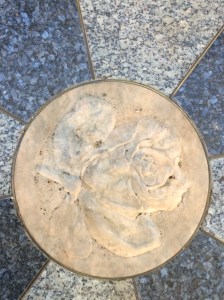 One of the reasons I liked this town so much is that the main square is wide open and flat. The walk into the Chiesa Madre San Giovanni Battista or St. John the Baptist, was only a few steps and not a dramatic 50 or 100+ easily encountered in Sicily. The church had been built by the Baron of Campobello di Licata, Raimondo Raimondetta who bought the village in 1681. The family emblem of the rose was visible inside the knave and outside on the sidewalks around the square.
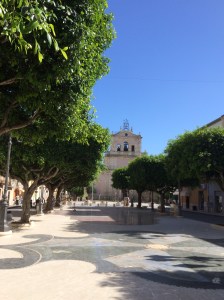 The main corso was unusual in it had trees growing along the walkways for shade and beauty. Apart from flower pots and balcony gardens, trees on the main boulevard in most cities were uncommon. There were kids drawing with chalk in the city square preparing for an art exhibit. The town municipal buildings are painted with several murals by Silvio Benedetto. He is a popular artist in Italy known for painting grand murals on public buildings in several Italian towns. Benedetto (which means the blessed) is a sculptor, illustrator, photographer, poet, dreamer, and visionary. He also has a keen eye for town planning. He came to Campobello di Licata during the 1980s and assisted with the major restoration of the downtown area. He brought a conceptual design to the squares, monuments and sculptures. The area surrounding the Chiesa Madre or Mother Church flows from one outdoor space to another. Benedetto likes curves and I
  tended to experience everything in a round shape. His art was so important, that he was given the entire municipal building as a canvas to paint on. Here is a photograph of his work. Clearly, the town embraced his vision and art for generations to come.
 On a practical note, the Sicilian need for locked doors took on a deeper dimension in Naro and Campobello. When I visited with Giuseppe and Giovanni both were at work with the shops open for business. An optometry shop and physiotherapist. However, the front door at both places is locked during business hours. People arriving for appointments are buzzed in. Curious! There wasn’t a lot of foot traffic in either town. They are not tourist destinations. Naro’s streets are so narrow that only tiny Fiat’s could make it around certain parts of the city. The town hall was open when I met Piero’s mom. Churches are open. But, a business is locked?
 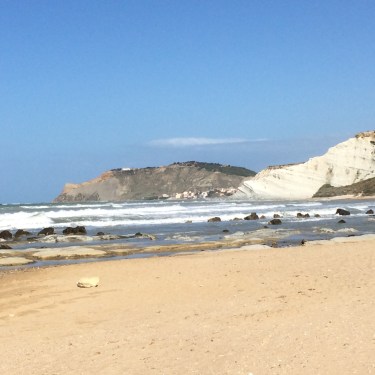 The walk is about fifteen minutes along the shoreline. The sea is on the left and a tumble down hillside angles up to the right. The slope increases, as I get closer to the cliff. Strange, the thing missing at all these seaside places is shore birds. Gulls are so common a sound and sight back home that it always feels like something is missing here. The aroma of sea air is also milder. The Atlantic Ocean makes itself known with a strong scent of seaweed, surf and sun when approached. The Mediterranean is more subtle, content to dazzle the eye at first.
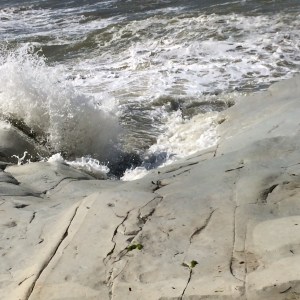 The sea fills the horizon and laps over the foot of the cliff. Tender waves turn the mottled white surface pigeon grey. This cliff face is made of marlstone, a lime-rich clay. When it’s wet, the stone is sleek and looks like the skin of a whale as it rises to the surface to draw breath. There is sensuality in the movement of water touching the rock. If the cliff could talk, she would say,
  Stepping onto the cliff face is easy. It seems made for humans or animals to climb. The surface looks like chalk and may be soft. Underfoot, it feels slightly tacky. Up close, it is more solid, but not strong like marble. Marlstone is lime rich mud, mudstone? It’s clay and silt. This substance, found in riverbeds, is an old familiar friend. This is the sort of mush frogs and small freshwater creatures love to be in. Mix in some sand, ash, crushed shell and this forms the basic plaster used in homes on the floors and walls for thousands of years. This is so familiar. Some part of me remembers walking on this before. Somehow, nature crystallizes the calcite in the minerals and creates this substance.
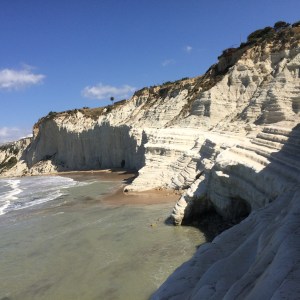 Who is she? Aeolus is present in the wind. Helios lights the eyes. Keep going and the cliff face gets longer, wider and taller. Rounding a bend, it keeps going for about two miles. The grooves are now getting steeper to walk on. I wish I had my walking stick. A brave soul with cleats on the shoe could keep going all the way around. The cliff rises up and up, down and down to the sea. I can see coves below. Secret places the sea can enter into the land. I decided to stop and sit on the stone. This looks much like a natural amphitheater. The way it pitches up gradually and is comfortable. The theater is the sea and sky. There are enough seats for thousands of spectators. So, it is time to gaze at the sea.
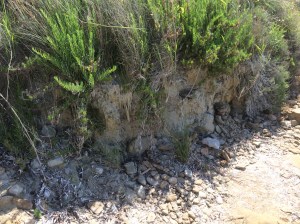 It is hard to leave here. How fine it is to feel overcome by the senses and know for a while that nothing else matters. This is the land of Demeter and Persephone, Artemis and Arethusa. I met Arethusa in Ortygia and found her journey led here in this little fresh water stream coming down the hillside. Her fate took her underground to dwell in safe passages. Here she is, she made it to the seashore at last.
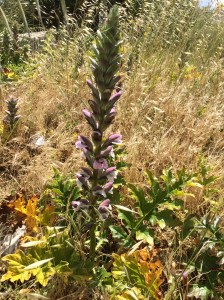 The Province of Agrigento contains well preserved Greek ruins. The Hellenic city of Selinunte is closer to the sea but also an easy drive from Naro. Akragas, the ancient name for Agrigento, was a major city of Magna Graecia and a few miles down the road, the famed Valle dei Templi is a short drive away. A casual way to determine if an area had been inhabited by Greeks is to look to the hillsides for acanthus. This flower grows in abundance at all Greek sites. Sicily has housed and fed external civilizations for ages. But, every town and city that flourishes today began as a humble settlement near a reliable source of water. Il Lago San Giovanni, an artificial lake completed in 1981, is fed by the river Naro. This area is dominated by agriculture and would need a plentiful, predictable supply of water. The translation of Naron in the Greek language is river. Perhaps the origin of the name.
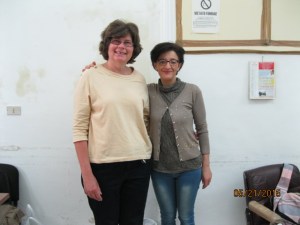 I was fortunate to meet with Signora Eleanora Ognibene. A man named Enzo became a part of the small group I was with and helped with translation as Signora spoke no English and my Italian was basic. She was able to take a few minutes away from her job to say hello to a fan from America.
 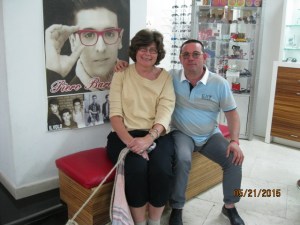 I went on to visit with a contact I had made through social media. Luxottica Minio, Naro’s optical shop was only a few steps down the Corso Vittorio Emanuele. I always thought so highly of this man who managed three shops, was raising a family, had his own life to lead but took the time to support Piero. The families of Barone and Minio seemed to be neighbors and friends. Signor provided all the eyeglasses that Piero wore. Piero wears eyeglasses on stage. I was what made him stand out to me from the start. Most performers are highly conscious of their appearance. There are very few entertainers who would be seen wearing glasses at all. Yet, Piero was rarely seen without them. He’s a handsome young man but appeared most comfortable and not concerned with appearances.
 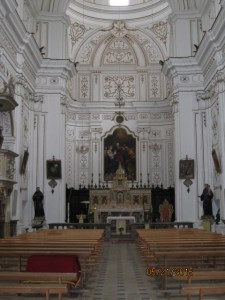 A guide was found with a smartphone app in English that helped during the tour of Chiesa di San Francesco and Chiesa di Caterina d’ Alessandria. The Baroque Chiesa di San Francesco, reconstructed in the late 1600s, was small and felt worn. Oh, it was clean and well-kept, but the floors seemed as if a thousand footsteps had passed over it. The walls were pure white with elaborate scroll work, paintings, and statuary everywhere. I was shown a relic of a pilgrim, bones and all, hidden behind a false door on a side altar. The guide took me behind the main altar at the front of the knave and into a room that smelled strongly of old, warpy wood. On three sides of the wall were heavily carved cabinets elaborately embellished. There was a font where the priests used to wash their hands before giving Communion. He showed me a cupboard that kept the most sacred objects of this church. There was a statue of Jesus, a crown of some sort and a carved object that looked like a sunburst with an eye in the center. The eye I had seen before in other churches in Noto and Modica: The All Seeing Eye.
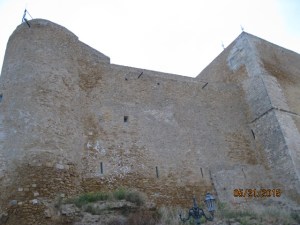 We took a long narrow road up and up to the very top of Naro. Here is the
 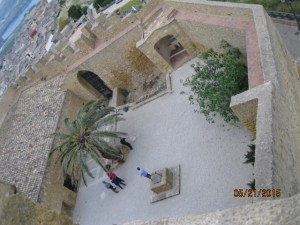 The day was gloomy with a heavy, cloudy sky. Inside the structure, the stones gave off a cold, clammy aura and felt unwelcoming. The hallways were narrow with high ceilings. The rooms on the right formerly housed the horses. It must have been so long ago as it doesn’t look at all like a stable. Everywhere, it was too close. A staircase wound around and up one flight into a display area for gowns and accoutrements from the Baroque Period. The pictorial display showed the last family that lived in the castle.
 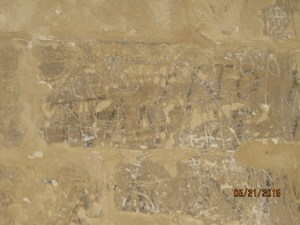 At one time, the castle was a prison. We were taken up into a large chamber with deep slotted windows. The walls were covered with etched graffiti from former inhabitants. What had they used to carve their names into the stone? As with every site visited in Naro, a person would become part of the group that knew quite a bit about the place. He sorted out I was keenly interested and started pointing out the markings. He showed me a carving of a mother and child. We found dates and names from so many years ago. Apparently, the light from the windows had been blocked out and the inhabitants left in the dark to ponder a hopeless situation. How many people have been here? What was their crime? Did they ever get out?
 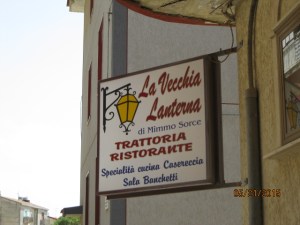 If you do find yourself in Naro, stop at the La Vecchia Lanterna on Via Palmiro Togliatti. They were known for their homemade ravioli. The pasta was hand rolled and filled with a finely diced mixture of tomato, carrot, lean beef, and garlic served with Nero d’Avola wine. The ragu had just a little heat. The beef or veal served were tender, lean and well cooked. Everything was very fresh. Despite the full plate of pasta, meat and salad. I was able to eat it all and not feel stuffed.
  LuceStellare