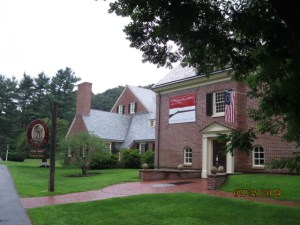
 Without hesitation, it can be said that no other town in Massachusetts can boast of being the remarkable birthplace to both the Revolutionary War and the resting place of Transcendentalism.
Both events represent an evolutionary shift in self-actualization both as a nation and a way of life. Several weeks ago, Jared Bowen, reporter for WGBH TV, Greater Boston, aired a segment on the Special Exhibition: Images of the Revolutionary War Generation & the Shot Heard ‘Round the World: April 19, 1775. This is one of several exhibits on display at the Concord Museum in Concord MA. Long fascinated by this event, it was only a matter of days before I traveled to and toured the museum.
The Concord Museum may be considered a first stop in town and a preparation for those visitors in search of forming a deeper connection to our Revolutionary War, the famed writer’s and philosophers of Concord and day to day life in the 1700 and 1800s.
The museum is laid out as a series of period rooms. The front foyer is a soaring space of tranquility and light. A portal into another time and place. The tour stats with a 15 minute video welcoming the visitor to the exhibit. Each room represents a different part of the history of the town. There is an outdoor courtyard and a small garden exhibit. The gift shop is charming and offers a wide variety of jewelry, literature, teas and keepsakes for everyone. This is a brief review of the museums exhibits and some of its contents.
Transcendentalism
This was a grassroots movement and belief crafted ever so sincerely from assembled persons of literary and philosophical note in and around this area in the 1830’s. From the Concord Museum:
Transcendentalism combined religion, philosophy, mysticism and ethics. Transcendentalists believed that:
All living things were bound together
Humans were essentially good
Insight was more powerful than experience as a source of knowledge
Those familiar with the Tao, will recognize many related beliefs and similar practices including reflecting that everything a person wishes to understand about the complex reality of life and life around us is to be explained by observation of the natural world. By recognizing that nature including the outer space of the solar system is the source of all inspiration and contemplation of such will bring about a state of equanimity.
The key players who practiced Transcendentalism in Concord are Nathanial Hawthorne, Henry David Thoreau, Ralph Waldo Emerson, Bronson Alcott, Louise May Alcott and Margaret Fuller. All of them were well educated, traveled and from established families in Massachusetts Bay Colony. All came to Concord to write, reflect and commune with like minded souls.
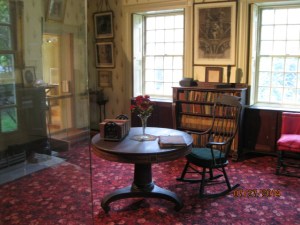 Emerson’s Study
The exhibit for Ralph Waldo Emerson is essentially the original furnishings from his study. The Emerson House is directly across the street from the museum’s location. The room reflects his personality. There was even an odor of stale paper and woodworms coming from the room. The fussiness of the carpet, the numerous photographs and prints of friends and admirers on the walls and the largess of the book collection sends a message down the generations as to who he was. I do believe he read every book on the shelf. He was the ultimate intellectual and advanced the idea of individual freedoms bound in Nature. Honestly, he is too brainy for me but devotees will love the experience of peering into his private study.
Thoreau Gallery
Devotees of Henry David Thoreau ought to make this a must stop on their tour through Massachusetts. After a visit to Walden Pond, I highly recommend coming to the Concord Museum Thoreau Gallery. The stark contrast between the Emerson and the Thoreau artifacts will tell its own story. Could two people be more different in outlook and the expression of Transcendentalism? Perhaps not but it is well-known they were dear friends and collaborators all their days.
On display are the desk, chair and bedframe from the cabin. Also the walking stick, snow shoes, and telescope. These were his “tools”. These objects followers will know were the essentials of which he often spoke. The one other object I did not know of was the Aeolian harp. While I have read of this ancient instrument, I did not realize it had earthly form still.
 From the Concord Museum:
Aeolian Harp – Named after the Greek god of the wind, an Aeolian harp is a musical instrument placed in a window and played by the wind. Thoreau’s workmanship is evident in this rosewood harp which he fitted for his window.
Not only did he have this, he made it himself. I tell you my heart paused to wonder what sound could be heard from this ancient instrument for the winds. Thoreau is brother earth, the harp is sister wind. He loved her so well that she was welcomed into his cabin by her own song. His poem:
Rumors from an Aeolian Harp
There is a vale which none hath seen,
Where foot of man has never been,
Such as here lives with toil and strife,
An anxious and a sinful life.
There every virtue has its birth,
Ere it descends upon the earth,
And thither every deed returns,
Which in the generous bosom burns.
There love is warm, and youth is young,
And poetry is yet unsung.
For Virtue still adventures there,
And freely breathes her native air.
And ever, if you hearken well,
You still may hear its vesper bell,
And tread of high-souled men go by,
Their thoughts conversing with the sky.
This review is not impartial. To me this man is above all others in thought, action and intention. I had forgotten how much I esteemed his life and activities until I saw the harp. Only Thoreau would have honored nature thus.
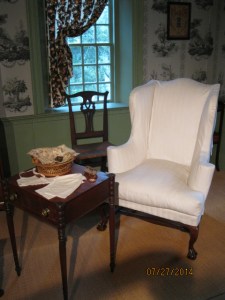 Early and Mid-1700s Rooms ~ 1800s Bed Chamber & Dining Parlor
The rooms are remarkable for their attention to detail. Each piece has its own card with provenance. Provenance establishes the history of a piece including place of origin, materials, cost, sales receipts, owners and donors. A sense of life in a well-appointed home of the period can be found in these rooms. No detail is left out including tableware, fabrics, pottery, coins, quill pens, and wallpapers. It’s a dream for any collector or person curious about daily life. The rooms are arranged as they would have been in there day.
The Shot Heard Round the World, April 19, 1775
This was the exhibit I was drawn to see. Assembled in the upper galleries are a vast collection of artifacts from this day. Many of the objects have been borrowed for the occasion so as to give the viewer an hour by hour account of the activities of the people of Concord on April 18 and 19.
The first piece the visitor will see is the lantern. One of the pair, (the 2nd is lost) of original lanterns…”if the British went out by Water, we would show two lanterns in the North Church Steeple, if by land one as a signal” In the chronicle of the Revolutionary War, what artifact could be more symbolic than this humble, time worn lantern. This light, this signal set Paul Revere in motion and the rest is American history.
The room contains the drum of William Diamond from the battlefield at Lexington. There are numerous muskets, powder horns, letters, muster sheets, documents, maps and notes saved for posterity from that fateful day. There is a collection of flints found at the site of the shot heard round the world at the Old North Bridge. To fire a musket took an elaborate preparation of the powder and gun. A piece of flint was used to spark the powder. These were used by the minutemen that day repelling the British marching over the bridge to raid the town armory. The museum provided a guide directly in this space to speak with and fully understand the significance of the collection and its place in American Revolutionary history even my query on what would have been the home address of Paul Revere was answered, dear reader he was Paul Revere of Boston, in the Colony of the Massachusetts Bay in New England.
 If the traveler comes by Concord, a stop at the Concord Museum is to be penciled in for the day. This is a not to be missed opportunity. The special exhibit is on display through September 21, 2014.
#revolutionary war
#ConcordMA
 “Owl Prelude (Ocala National Forest, Florida)
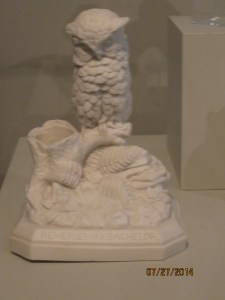 Reveries of a Bachelor (Lonely Owl)
 The pair read: Matchmaking
 LuceStellare