On the Road May 2015
 On the tenth day of my adventure, I am in San Leone at a seaside cottage in Agrigento Province. On this morning, I saw the natural wonder of La Scala dei Turchi in nearby Realmonte. I spent some time in the presence of this great beauty. Now I understand how myths are formed. I wouldn’t be surprised to find that on moonlit evenings, sea nymphs lounge on the steps. After a lunch break and a little rest, I headed into Campobello di Licata to meet a friend I had made via social media. I was excited and expectant as to what this meeting could bring. We’d not met in person and I took it on a leap of faith that this could be fun.
This small town is tucked away in Agrigento Province about one hour’s drive from Licata which is near the sea. The roads are graceful, winding around cultivated fields of grain, olive and citrus trees, grapevines, and vegetables. The island so far, doesn’t have large stands of forests. I have yet to see an evergreen tree. The day was light and airy with fresh breezes ruffling the meadows. Campobello in English means beautiful field.
 The day before this visit, I had been in Naro, a neighboring town steeped in medieval and baroque architecture. Naro felt ancient compared to Campobello. The streets are wider. The buildings are constructed of honey colored local stone with a fine stucco of light butter cream. Relatively speaking, the town actually is newer than Naro. Campobello relocated from the original settlement, as the water source was low lying and a breeding ground for malaria. Before one stone moved, a steady spring of clean water was found. The well in this picture was built in 1056 and was the original water source for the old town. This had been the center of activity for centuries and the place women walked to daily for water. Now, it is quiet, if only this well could talk, the stories it could share.
The commune’s formal name is Campobello di Licata Citta d’ Arte or the City of Arts. I was soon to find out why. My social media friend, Giovanni is a physiotherapist with a private practice on Van Gogh Street. Right away, I felt at ease in his company. He has a quiet way of moving about and took pride in showing me his business and accomplishments. He is intelligent, soft-spoken and generous. I got the impression this guy has a funny bone that given more time, I would have come to know.
After we exchanged greetings, and gifts, he quickly introduced me to another artist of prominence associated with the town named Silvio Benedetto. We spent quite some time in exploring this man’s art. Giovanni was kind enough to arrange a tour. His daughter Francesca, Piera and Uncle Giuseppe Rotolo, joined us. Signor Rotolo had lived in the United States and spoke English. My Italian was weak but growing stronger each day. Between the two of us, we managed to exchange quite a bit of history about the town.
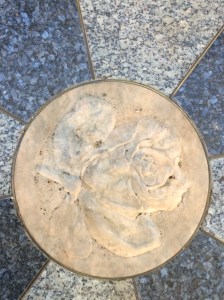 One of the reasons I liked this town so much is that the main square is wide open and flat. The walk into the Chiesa Madre San Giovanni Battista or St. John the Baptist, was only a few steps and not a dramatic 50 or 100+ easily encountered in Sicily. The church had been built by the Baron of Campobello di Licata, Raimondo Raimondetta who bought the village in 1681. The family emblem of the rose was visible inside the knave and outside on the sidewalks around the square.
We toured Piazza Aldo Moro with its lively, large fountain splashing around sculptures of children and stones. We went into La Fenice café for gelato. My favorite flavor is nocciola; hazelnut ice cream blended with nutella. Gelato has a creamy, smooth texture on the tongue. The basic recipe includes eggs, heavy cream and whole milk. It’s not too sugary, just naturally lovely and satisfying. While we were being served, I noticed everyone sitting down in the café were men. This was around 3 o’clock in the afternoon. There were photographs of Marilyn Monroe and Audrey Hepburn on the walls. I asked Piera where all the women were? At home she said. This is a pattern I noticed in every Sicilian town. The men congregated and chatted at cafes, barber shops, and the bar. I must have given them something to talk about for days. I don’t think many Americans visit Campobello di Licata.
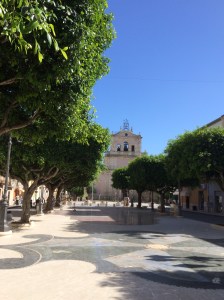 The main corso was unusual in it had trees growing along the walkways for shade and beauty. Apart from flower pots and balcony gardens, trees on the main boulevard in most cities were uncommon. There were kids drawing with chalk in the city square preparing for an art exhibit. The town municipal buildings are painted with several murals by Silvio Benedetto. He is a popular artist in Italy known for painting grand murals on public buildings in several Italian towns. Benedetto (which means the blessed) is a sculptor, illustrator, photographer, poet, dreamer, and visionary. He also has a keen eye for town planning. He came to Campobello di Licata during the 1980s and assisted with the major restoration of the downtown area. He brought a conceptual design to the squares, monuments and sculptures. The area surrounding the Chiesa Madre or Mother Church flows from one outdoor space to another. Benedetto likes curves and I
  tended to experience everything in a round shape. His art was so important, that he was given the entire municipal building as a canvas to paint on. Here is a photograph of his work. Clearly, the town embraced his vision and art for generations to come.
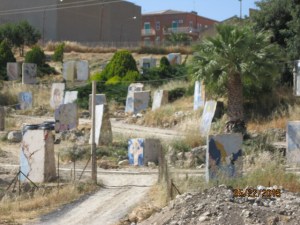
I was taken to view the Parco della Divina Comedia currently under construction. There are 102 stones all with characters and scenes from The Divine Comedy by Dante Alighieri. The exhibit had been on display in Rome and was now being permanently placed right in Campobello di Licata. Dante is so well admired beyond Italy, that I can well imagine this becoming a destination for both fans of Benedetto and Dante. Giovanni talked about a museum for Silvio Benedetto at, Le Gole Alcantara Parco Botanico e Geologico near Taormina in the Province of Siracusa.
 On a practical note, the Sicilian need for locked doors took on a deeper dimension in Naro and Campobello. When I visited with Giuseppe and Giovanni both were at work with the shops open for business. An optometry shop and physiotherapist. However, the front door at both places is locked during business hours. People arriving for appointments are buzzed in. Curious! There wasn’t a lot of foot traffic in either town. They are not tourist destinations. Naro’s streets are so narrow that only tiny Fiat’s could make it around certain parts of the city. The town hall was open when I met Piero’s mom. Churches are open. But, a business is locked?
All in all, I had a wonderful visit to Campobello di Licata, and like everywhere I had been in Sicily, there was more to see and appreciate. I promise myself to return with better language skills and to devote more energy to exploring these quiet corners of Sicily. I wanted most to stay in Agrigento Province with its rolling hillsides, cool evening breezes, and soft sunshine. I am grateful to the Nigro and Rotolo family for taking the time to fill me with precious memories of a wonderful day.
 LuceStellare