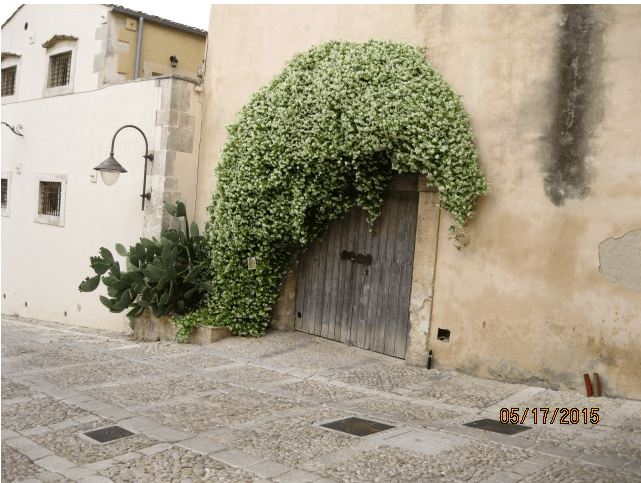
After one night and day in Taormina, it was time to drive south passing the coastal cities of Catania and Siracusa on the way to Citta di Noto, Giardino di Pietra, the city of Noto, Garden of Stone. It was late afternoon when the driver picked me up and I was taken to a rented townhouse which became my home base for a few days. The autostrada, the Italian version of the interstate, reminded me of Route 128 in greater Boston with connectors, off ramps, and tunnels. The two lanes that traveled north and south were narrow and it felt like driving on a big curve all the time. Drivers buzzed along and exits came up fast. I am not sure what I expected, but it all felt quite modern and efficient.
There was an abundance of flora growing alongside the highway. I saw tall, broad shrubs that resembled scented geraniums blooming in dazzling shades of white, red, and pink. Cacti that looked like a cross between prickly pear, aloe, and yucca grew along the embankments. The driver said it was edible and harvested in late August. Yellow broom plants were in bloom everywhere. Once past the city limits of Catania, the scenery gave way to rolling hills under cultivation. How sparsely populated it seemed. Brilliant red poppies grew along field borders. Groves of citrus, olive, and nut trees were everywhere. Sicilia è un po’ di paradiso! Sicily is a little bit of paradise. I came for the annual May Festival, L’Infiorata di Noto, or Noto in bloom. An elaborate citywide celebration of fine architecture in the Baroque Style, a grand floral display, a pageant, and classical artistic performances.
The festival was not until Sunday, as it was Thursday, I had a few days to explore the Province of Siracusa. Instead of reserving a hotel room, a small house was rented. A house tells a story about the owners and a way of life. My goal was to attempt to live like a local and blend in rather than be another tourist. Uncertainty arose when I had tried to secure directions from the host prior to leaving the U.S. When I asked Giovanni, the contact for the rental, he was vague, not providing any route of navigation at all. He did offer to meet me somewhere in town and be an escort if necessary. I asked again wondering if my Italian was off. Niente! Nothing! After a few missed turns, the drivers GPS got us to the house at Number 10 Milano.
I arrived and was welcomed into the house by Giovanni’s mother. She lived on the other side of a one story house divided down the middle to create side by side residences. Each home had a separate entrance with an interior door that connected the two residences inside. As it turned out, Giovanni had a job and apartment in Catania. He spoke English, but relied on his mother to help with lodgers. Eleanora spoke directly to me but I struggled to follow the conversation. She was a middle aged woman, fit and slender in a flattering pantsuit. Her hair was a light brown cut short and brushed off her face. We were probably close in age.
Before I had a chance to see around the house, she took me for a walk around Noto during the evening promenade. Italians love to stroll near sunset to take in the air, socialize, and pass the evening. She warned me to avoid a certain alley and not to take a shortcut. This was a hospitable thing to do for a stranger traveling alone. It made me feel someone was watching out for my best interest and expecting to see me routinely. The city is laid out with a main boulevard leading straight to the old gate, a huge arch large enough for an elephant to walk through that at one time may have had a wooden gate.
We paused at the edge of the city at the lookout point known as the belvedere or beautiful view. There was sparse vegetation and olive trees growing along the hillside. These trees seemed to be out of order from what I had been seeing, growing almost wild. On the drive, I noticed Sicilian farmers planted everything in straight lines. It was funny considering the general disdain for standing in line, to see this little copse conform to a different standard. The plantings curved along the hillsides in perfect lines. These olive trees were doing their own thing. Did the beautiful view refer to this area of wildness? It hadn’t been cultivated in quite some time. Maybe I was seeing things through eyes accustomed to green woodlands abundant with brooks and ponds.
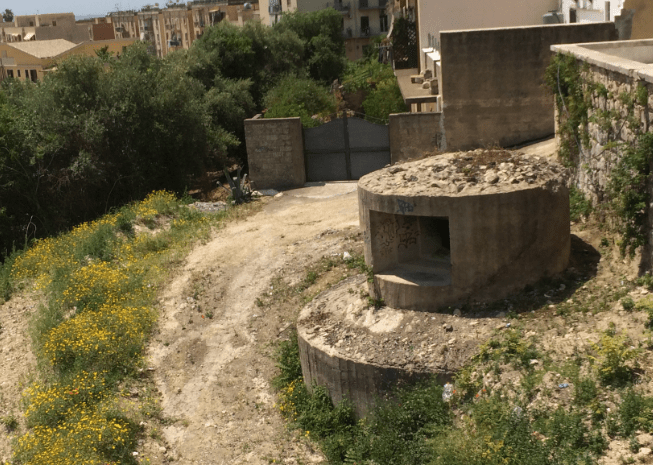
In a shallow ravine, at the base of the viewing area was a World War II lookout post. The round low turret felt ominous and reminded me, we were once on opposite sides of the war. Men would have been in there watching out for soldiers attempting to bring combat to the city. On the main street or corso, later I would find a few statues and monuments dedicated to those who were lost in the war. It was unsettling to realize that although it was peaceful now, seventy years ago, Italy was at war with the Allies.
At Casa Cuseni, a bookcase in the hall had a stack of old paperbacks. I took one of them for a read guessing the author may have been a resident. “Captain Corelli’s Mandolin” written by Louis de Bermieres is a story of life on a small Greek island during the war years; what it was like to be occupied by the Italian and later German army. It felt authentic in its awfulness of what local people endured.
The one thing that did not happen was I thought I said to her, let’s have a bite to eat during the promenade. We did not. We walked by many trattoria (local eateries) but never went in. I guess my Italian was all wrong and she spoke no English at all. When we got back to the house, I had a choice to make, whether to go out again or make do with what the host provided in the fridge. I was tired and hot so I stayed in the house enjoying fruit, tea, and breakfast rolls with jam. The rest of the evening passed with becoming accustomed to my new home.
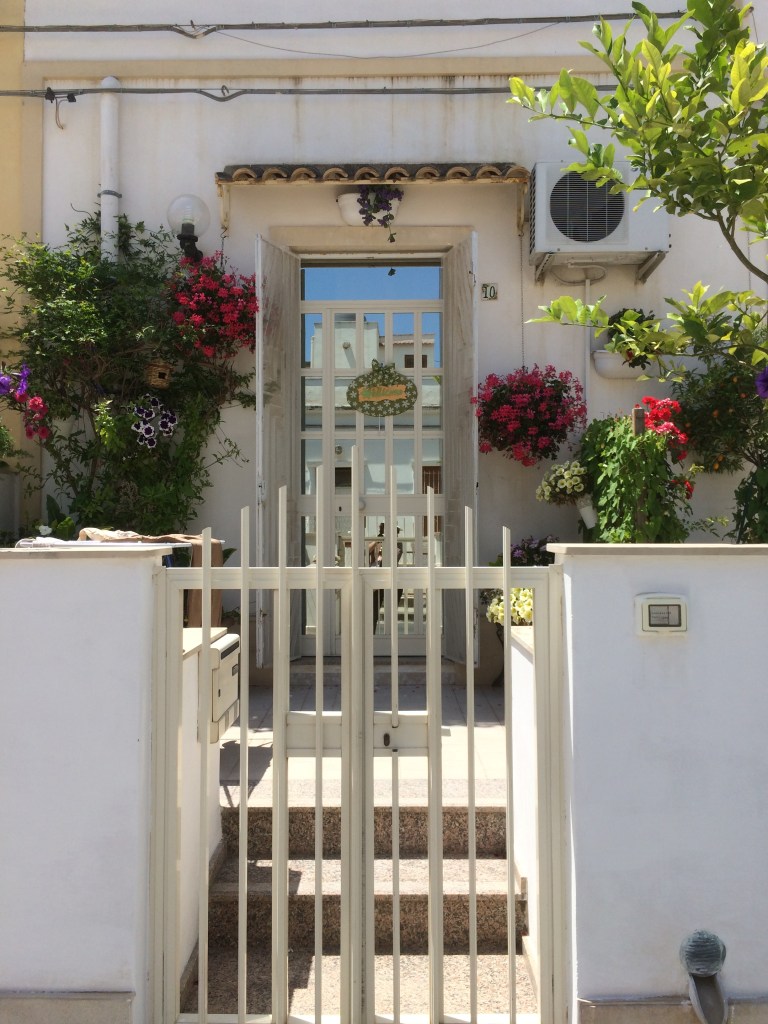
The entrance was through a small metal gate the color of sand, and up a short flight of stone steps. There was a small table and chairs on the left side of a wide verandah with potted flowering geraniums. The glass paneled front door opened directly into the living room. The house was quiet. An embroidered drape hung on the back of the front door acting as a screen, letting the cool evening air in; providing beauty with privacy. The house was spacious, and cool. The island was blessed with an evening breeze and low humidity. The day could get toasty, but the nights were refreshing.
A short hall led past the bedroom, and bath to the kitchen at the back of the house. The skylight in the kitchen helped make the space feel bigger than it was and provided natural light. I would hear birds cooing on the roof in the morning making it feel I was not in downtown Noto. There was a full size fridge, sink, gas oven and small dining table flush against the back wall with two chairs. Oddly there was no back door. The only windows were in the front room. They let in plenty of daylight. A tall, wide bookcase in the living room took up an entire wall filled with books, trophies and college texts. A small glass topped desk became the home base for my laptop. Internet service was provided and helped me get in touch with friends back home. I loved the wingback leather desk chair as I discovered it was the only comfortable seat in the house. The loveseat in the living room was super stiff and I never could relax into it. The high ceilings and flat stone floors made for a comfortable space. The house was maybe 900 square feet and larger than my own back in Massachusetts.
I figured out how to light the gas stove, run the bath, and flush the toilet. The only thing lacking as far as conveniences was a washing machine. I assumed I could walk to the neighborhood laundromat but was startled to hear that in a city that size, there would be no such business. I would have to go to a bigger city. There are about 24,000 people living in Noto. Isn’t that large? I found a drying rack behind the refrigerator and soap for hand washing under the kitchen sink. A do-it-yourself laundry. The sun was strong and on a good day, the wash could dry in a few hours.
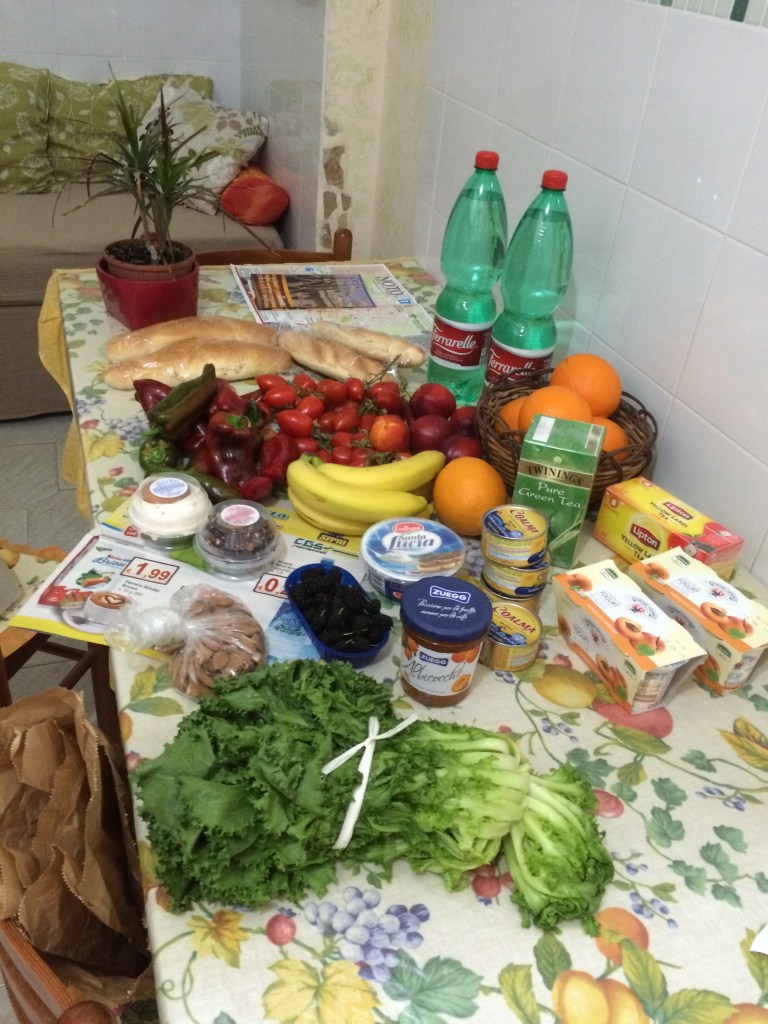
I went food shopping the second day in Noto at a small neighborhood market and farm stand. CGS Supermercati on Via A. Toscanini. The market was like those in the US but five times smaller. I had fun strolling the aisles buying from the weekly flyer. A few American brands made it onto the shelf with Lipton tea, Kraft Philadelphia cream cheese, McCain frozen French fries and Huggies diapers. In Sicily I discovered, it’s the norm to bring your own bags and bag it yourself. Everything was fun until the check out. The cashier was brusque and shoved everything down the conveyor. Her facial expression was bored, and impatient. A lot of bad vibes were coming out. The impression was, hurry up, pack up and get out. I guess she didn’t pick up on my starry eyed tourist feeling? I don’t think I looked like a local.
The receipt from the visit reflected a typical one for me from the US. I like sparkling mineral water, mascarpone cheese, yogurt, tuna in olive oil, and gelate la dolce vita, sweet desserts! I was not there to be a typical tourist and wanted a little bit of normal home life. I like routines and was attempting to recreate my American lifestyle while living here. Language skill had not been necessary in the market. This domestic adventure grounded me and helped me have an interaction without the pressure of acceptance in a strange place. I was just another customer, it fulfilled my goal of blending in.
About two city blocks away from the townhouse, at the end of the main road near the public park in Noto, vendors sold all kinds of local specialties in an open air market on Wednesday’s. There were bags of almonds from the orchards outside town, piles of sun dried tomatoes and mulberries! Local vineyards sold my favorite Nero d’Avola wine. The coastal town of Avola was close by. There were pistachio cookies from Pachino. The chocolates were from nearby Modica. There was pesto, pasta, herbs and so much more. The market had just a few booths, but nothing from home compared to the variety and freshness I found here. Even the prices were friendly. I made a video of the walk through and can share it on this link. I had budgeted €30 a day for food, but it was easy to eat well on €20 a day and that included a cannoli. Italy is well known for the cuisine and so far, that was proving to be as beautiful as the cities I was beginning to explore.
Everyday, I set out on an adventure to different towns. The hired driver met me outside the house gate and off we’d go to Modica, Ragusa or Siracusa. While I was glad to let someone else take me about, I realized travel book writers recommendations about Sicilian drivers weren’t meeting expectations so far. They had warned to be careful of hazardous drivers and frequent accidents. Because of the shortness of time on the island and a larger fear of becoming stranded somewhere, I sought out a driver. I wasn’t ready to tackle a new language, culture, and try to read road maps as well. Fear, a recognition of my own limits and healthy fear kept me from daring to hire a car and get around on my own.
In general, Sicilians seemed like drivers everywhere. They knew where they were going and tourists did not. We hesitate, block the intersection, drive slowly and get confused. The main roads were no more narrow or winding than in Massachusetts. A traffic circle tended to appear often but most had helpful signage.
The cities had one or two main roads in and out, however the streets and avenues in town went in many different directions. In some instances, a narrow lane, almost a walkway, was considered a road. Some streets made a 90 degree turn or became an alley or a dead end. The GPS did a fairly good job of locating destinations. Three wheeled vehicles known as ape were common to see and smart given the roads.
Parking at curbside could be a problem and the smaller the car the better. There was metered parking in Modica. Typically, a car park is near the entrance to each city or town. It costs a few dollars to leave it and walk into town. The frantic, mad dashing driver in dented cars written about were not to be seen. Nobody rushed us, nobody laid on the horn or ignored the rules of the road. The sight of the familiar red octagon STOP sign so common at home surprised me. The driver said they are common in Italy. Also, there was not a single traffic light in Noto, not even a flashing yellow beacon anywhere in the city.
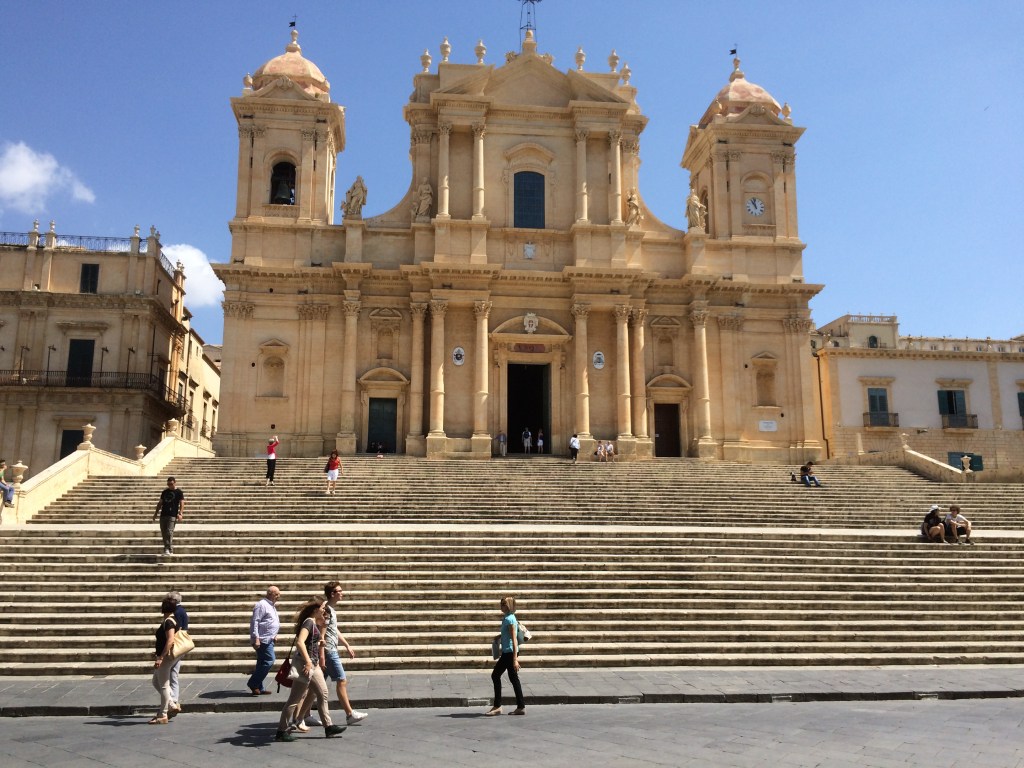
Noto was beautiful. The city was built into a long hillside with great views into the Valley of Noto. The stones had a lovely shade of cream, sea sand and a little copper blended in for tone. Every building and church in the old city was ornate and powerful in its feeling of strength and solidness. Glancing up the street where I “lived” for a few days, I saw women wash their front steps and toss the water out into the street. Cats ambled along the walkways. The residents hustled home for lunch at 1 o’clock in the afternoon and did not emerge until around four p.m. My goal of fitting in and living as a resident was happening. If I had stayed with that group from the US, I would have missed out. It would have been a stop or two a day, like a traditional tourist. Thank the goddess I listened to myself and walked my own path.
 LuceStellare